How to use this calculator
Solve an ideal energy balance for the strike-water temperature that heats grain and a mash vessel to a target.
- Enter Dry grain mass (kg), Grain specific heat (kJ/kg/°C), Initial grain temperature (°C), Strike water mass (kg), then complete the remaining labeled fields. Match the units shown beside each field and review the result together with the assumptions below.
- Read the worked example below to check the expected input format and result.
- Compare another scenario by changing one input at a time. Use Reset to return to the starting values.
Mash strike water heat balance explained
Solve a heat-capacity balance for the strike-water temperature needed to bring the entered grain and tun toward the target mash temperature.
How the calculation works
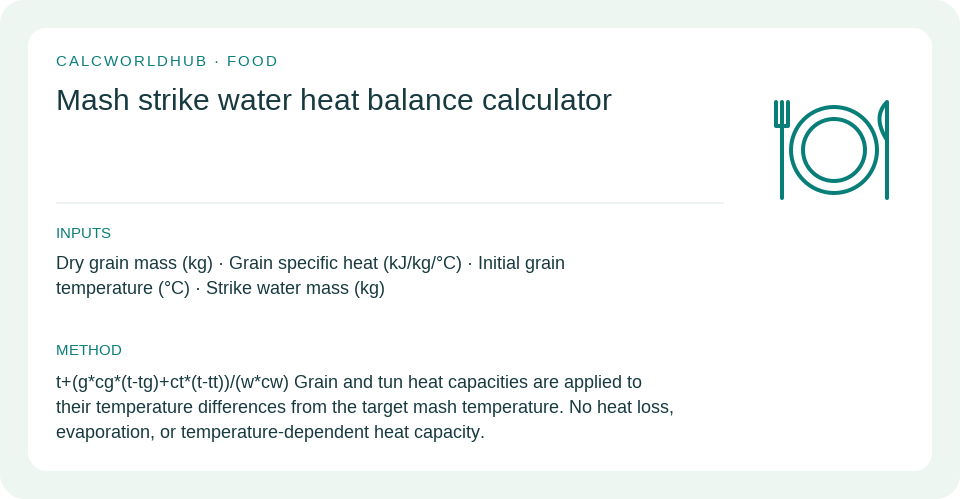
t+(g*cg*(t-tg)+ct*(t-tt))/(w*cw)
Grain and tun heat capacities are applied to their temperature differences from the target mash temperature. No heat loss, evaporation, or temperature-dependent heat capacity.
Sources
- A Hands-On Guide to Brewing and Analyzing Beer in the Laboratory — Describes calculating required strike-water temperature for a mash; equipment and heat-loss assumptions still vary.
Inputs and units
g— Dry grain mass (kg)- Dry grain mass (kg).
cg— Grain specific heat (kJ/kg/°C)- Grain specific heat (kJ/kg/°C).
tg— Initial grain temperature (°C)- Initial grain temperature (°C).
w— Strike water mass (kg)- Strike water mass (kg).
cw— Water specific heat (kJ/kg/°C)- Water specific heat (kJ/kg/°C).
ct— Mash vessel heat capacity (kJ/°C)- Mash vessel heat capacity (kJ/°C).
tt— Initial vessel temperature (°C)- Initial vessel temperature (°C).
t— Target mixed temperature (°C)- Target mixed temperature (°C).
Limits of this model
No heat loss, evaporation, or temperature-dependent heat capacity. Grain and vessel heat capacities must match the actual equipment and ingredients.
Check this example
Dry grain mass (kg) = 5; Grain specific heat (kJ/kg/°C) = 1.6; Initial grain temperature (°C) = 20; Strike water mass (kg) = 15; Water specific heat (kJ/kg/°C) = 4.186; Mash vessel heat capacity (kJ/°C) = 2; Initial vessel temperature (°C) = 20; Target mixed temperature (°C) = 68.
- Mash strike water heat balance: 75.644529 °C
For the entered grain, tun, and target values, the heat balance gives a strike-water temperature of 75.6445 °C; the inputs’ heat capacities and masses drive the correction above the 68 °C target.
Frequently asked questions
Why include vessel heat capacity?
A cold vessel absorbs heat in addition to the grain.
Is water volume entered?
Use water mass; convert measured volume consistently.
Does it compensate for heat lost during transfer?
No, that needs an added measured allowance.
How do I use the Mash strike water heat balance calculator?
Enter Dry grain mass (kg), Grain specific heat (kJ/kg/°C), Initial grain temperature (°C), Strike water mass (kg), then complete the remaining labeled fields. Match the units shown beside each field and review the result together with the assumptions below.
What is a worked example of Mash strike water heat balance?
Dry grain mass (kg) = 5; Grain specific heat (kJ/kg/°C) = 1.6; Initial grain temperature (°C) = 20; Strike water mass (kg) = 15; Water specific heat (kJ/kg/°C) = 4.186; Mash vessel heat capacity (kJ/°C) = 2; Initial vessel temperature (°C) = 20; Target mixed temperature (°C) = 68. Mash strike water heat balance: 75.644529 °C For the entered grain, tun, and target values, the heat balance gives a strike-water temperature of 75.6445 °C ; the inputs’ heat capacities and masses drive the correction above the 68 °C target.
Read our calculation methodology.