How to use this calculator
Size equal shunt resistors and the series resistor in an ideal impedance-matched pi attenuator pad.
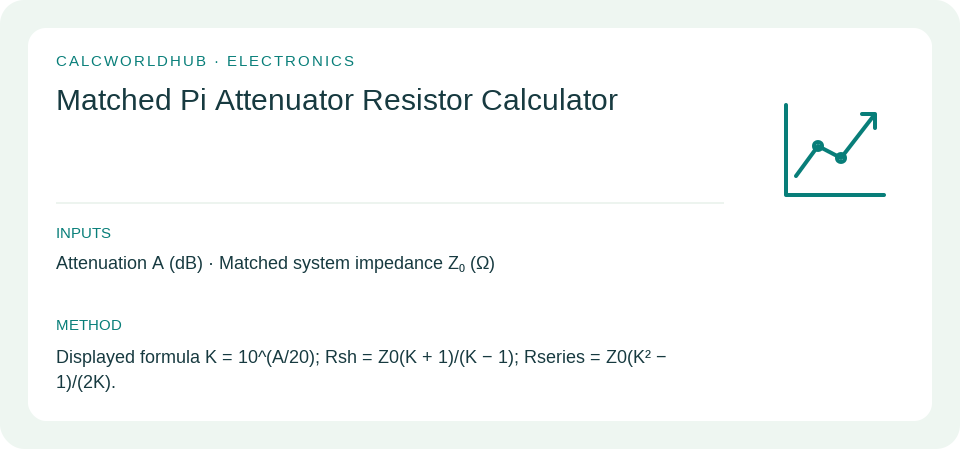
- Enter Attenuation A (dB), Matched system impedance Z₀ (Ω). Match the units shown beside each field and review the result together with the assumptions below.
- Read the worked example below to check the expected input format and result.
- Compare another scenario by changing one input at a time. Use Reset to return to the starting values.
How this calculation works
A resistive π pad reduces voltage while presenting the same nominal resistance at its input and output when it is terminated in the design impedance. Enter the desired attenuation in decibels and the matched system impedance. The calculator returns the two equal shunt-arm values and the single series-arm value for the ideal symmetric network.
Inputs and units
attenuation— Attenuation A (dB)- Enter a positive matched voltage attenuation from 0.01 to 120 dB.
impedance— Matched system impedance Z₀ (Ω)- Use the source and load impedance the pad must match.
Formula
K = 10^(A/20); Rsh = Z0(K + 1)/(K − 1); Rseries = Z0(K² − 1)/(2K).
Method
Convert voltage attenuation A in decibels to the matched voltage ratio K. Solve the symmetric π-network matching and attenuation equations for the common shunt resistance and the center series resistance.
Worked example
For a 10 dB pad in a 50 Ω system, the two shunt resistors are about 96.25 Ω each and the series resistor is about 71.15 Ω.
Assumptions and limits
Assumes an ideal, symmetric, purely resistive π pad with equal source and load impedance. Real resistor tolerances, parasitic inductance and capacitance, power dissipation, frequency limits, and thermal derating are not included.
Frequently asked questions
Why are the two shunt resistors equal?
This page designs a symmetric pad with the same source and load impedance.
Does a 10 dB pad reduce voltage by 10 times?
No. The voltage ratio is 10^(10/20), about 3.162, in a matched system.
Can I build the pad from any resistor wattage?
No. This ideal calculation gives resistance values only. Check power dissipation, voltage rating, frequency response, and temperature limits for the application.
How do I use the Matched Pi Attenuator Resistor Calculator?
Enter Attenuation A (dB), Matched system impedance Z₀ (Ω). Match the units shown beside each field and review the result together with the assumptions below.
What is a worked example of Matched Pi Attenuator Resistor?
For a 10 dB pad in a 50 Ω system, the two shunt resistors are about 96.25 Ω each and the series resistor is about 71.15 Ω.
Reference: technical reference. See our calculation methodology.