How to use this calculator
Assess sphericity of repeated-measures contrasts using Mauchly’s W and a clearly labeled first-order chi-square approximation.
- Enter Complete subject rows by condition, Repeated conditions per subject. Match the units shown beside each field and review the result together with the assumptions below.
- Read the worked example below to check the expected input format and result.
- Compare another scenario by changing one input at a time. Use Reset to return to the starting values.
Mauchly repeated measures sphericity test explained
Mauchly’s test evaluates whether within-subject contrast variances support the sphericity assumption used by univariate repeated-measures ANOVA. It estimates W from complete subject-by-condition rows and uses a chi-square approximation; small samples and non-normal data can make that approximation unreliable.
Inputs, symbols, and units
x— Complete subject rows by condition- Complete observations flattened row by row. For repeated measures each row is one subject; otherwise each row is one independent multivariate observation. Use comma-separated values in the stated order.
k— Repeated conditions per subject- Repeated conditions per subject row, from three through eight. The subject count is derived from the data list. Enter a whole number.
Formula and method
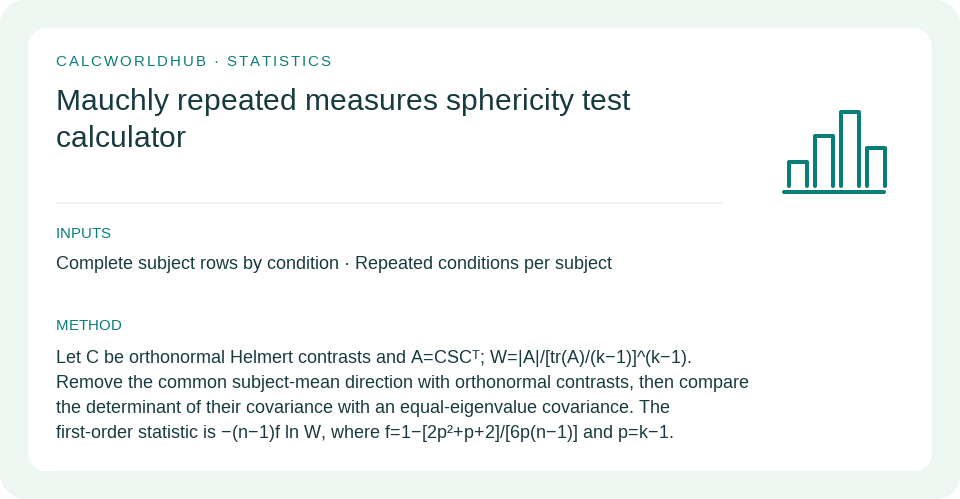
Let C be orthonormal Helmert contrasts and A=CSCᵀ; W=|A|/[tr(A)/(k−1)]^(k−1).
Remove the common subject-mean direction with orthonormal contrasts, then compare the determinant of their covariance with an equal-eigenvalue covariance. The first-order statistic is −(n−1)f ln W, where f=1−[2p²+p+2]/[6p(n−1)] and p=k−1.
A worked scenario
Complete subject rows by condition = 2,3,5,3,2,4,4,6,5,5,4,8,6,7,7,7,5,9,8,9,10,9,7,11; Repeated conditions per subject = 3.
- Mauchly sphericity W: 0.40919931
- First-order corrected chi-square: 5.3613176
- First-order approximate p-value: 0.068518
- Degrees of freedom: 2
Eight subjects each supply three repeated conditions. Contrasting within rows removes level differences between subjects and leaves two contrast dimensions for the sphericity calculation.
Assumptions and edge cases
Complete independent multivariate-normal subject rows, at least k+1 subjects, and positive-definite contrast covariance. The p-value uses first-order correction only and can differ from software with second-order terms. It does not automatically correct an ANOVA.
Reading the outputs
W near one means contrast covariance eigenvalues are similar. The test concerns the covariance of contrasts, not equality of condition means or raw condition variances alone.
Frequently asked questions
Is sphericity identical to compound symmetry?
No. Compound symmetry is a stronger covariance restriction.
Are missing repeated measurements allowed?
No. The calculation requires complete subject rows.
Does a small p-value choose a correction automatically?
No. Greenhouse–Geisser or other analysis decisions require a separate repeated-measures model.
How do I use the Mauchly repeated measures sphericity test calculator?
Enter Complete subject rows by condition, Repeated conditions per subject. Match the units shown beside each field and review the result together with the assumptions below.
What is a worked example of Mauchly repeated measures sphericity test?
Complete subject rows by condition = 2,3,5,3,2,4,4,6,5,5,4,8,6,7,7,7,5,9,8,9,10,9,7,11; Repeated conditions per subject = 3. Mauchly sphericity W: 0.40919931 First-order corrected chi-square: 5.3613176 First-order approximate p-value: 0.068518 Degrees of freedom: 2 Eight subjects each supply three repeated conditions. Contrasting within rows removes level differences between subjects and leaves two contrast dimensions for the sphericity calculation.
Method reference: R stats: Mauchly sphericity test.
Read our calculation methodology.