How to use this calculator
Find the maximum work a reversible engine can extract before two finite constant-heat-capacity bodies reach one temperature.
- Enter Hot body heat capacity (kJ/K), Initial hot-body temperature (K), Cold body heat capacity (kJ/K), Initial cold-body temperature (K). Match the units shown beside each field and review the result together with the assumptions below.
- Read the worked example below to check the expected input format and result.
- Compare another scenario by changing one input at a time. Use Reset to return to the starting values.
Maximum reversible work between finite thermal bodies explained
A numerical walkthrough
Hot body heat capacity (kJ/K) = 10; Initial hot-body temperature (K) = 600; Cold body heat capacity (kJ/K) = 15; Initial cold-body temperature (K) = 300.
- Final reversible equilibrium temperature: 395.852373 K
- Maximum recoverable work: 603.690669 kJ
- Heat removed from hot body: 2041.476268 kJ
Finite hot and cold bodies have heat capacities 10 and 15 kJ/K at 600 and 300 K. A reversible engine between them reaches 395.852 K with 603.691 kJ maximum work; heat extraction declines as their temperatures approach each other.
The model behind the numbers
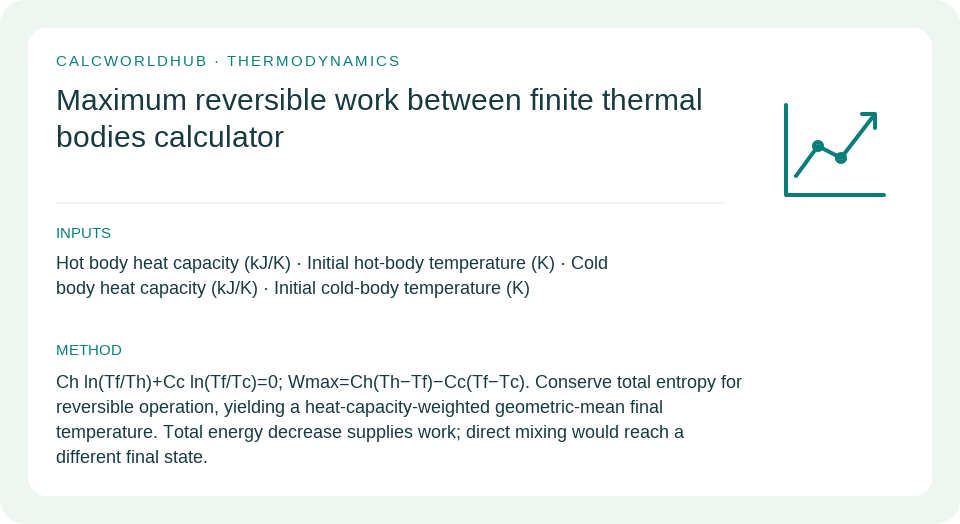
Ch ln(Tf/Th)+Cc ln(Tf/Tc)=0; Wmax=Ch(Th−Tf)−Cc(Tf−Tc).
Conserve total entropy for reversible operation, yielding a heat-capacity-weighted geometric-mean final temperature. Total energy decrease supplies work; direct mixing would reach a different final state.
What to enter
Ch— Hot body heat capacity (kJ/K)- Hot body heat capacity (kJ/K). Enter the value for this state; the units shown are used without an unstated conversion.
Th— Initial hot-body temperature (K)- Initial hot-body temperature (K). Enter the value for this state; the units shown are used without an unstated conversion.
Cc— Cold body heat capacity (kJ/K)- Cold body heat capacity (kJ/K). Enter the value for this state; the units shown are used without an unstated conversion.
Tc— Initial cold-body temperature (K)- Initial cold-body temperature (K). Enter the value for this state; the units shown are used without an unstated conversion.
Interpreting the result
Thermally insulated pair apart from reversible engine exchanges, constant heat capacities, no phase change and no external ambient reservoir.
Reading the outputs
Final temperature is kelvin, work and removed hot-side heat are kJ.
Frequently asked questions
Why is final temperature a geometric mean?
Reversibility conserves the sum of logarithmic entropy changes.
Would direct contact reach the same final temperature?
No. With no work extraction, direct contact conserves total thermal energy and yields an arithmetic weighted average.
Can the two heat capacities differ?
Yes. Their ratio sets both entropy weights and final temperature.
How do I use the Maximum reversible work between finite thermal bodies calculator?
Enter Hot body heat capacity (kJ/K), Initial hot-body temperature (K), Cold body heat capacity (kJ/K), Initial cold-body temperature (K). Match the units shown beside each field and review the result together with the assumptions below.
What is a worked example of Maximum reversible work between finite thermal bodies?
Hot body heat capacity (kJ/K) = 10; Initial hot-body temperature (K) = 600; Cold body heat capacity (kJ/K) = 15; Initial cold-body temperature (K) = 300. Final reversible equilibrium temperature: 395.852373 K Maximum recoverable work: 603.690669 kJ Heat removed from hot body: 2041.476268 kJ Finite hot and cold bodies have heat capacities 10 and 15 kJ/K at 600 and 300 K. A reversible engine between them reaches 395.852 K with 603.691 kJ maximum work; heat extraction declines as their temperatures approach each other.
Read our calculation methodology.