How to use this calculator
Find what fraction of equilibrium gas molecules lie in a selected speed band instead of representing the gas by one average speed.
- Enter Equilibrium gas temperature (K), Molar mass (g/mol), Lower speed (m/s), Upper speed (m/s). Match the units shown beside each field and review the result together with the assumptions below.
- Read the worked example below to check the expected input format and result.
- Compare another scenario by changing one input at a time. Use Reset to return to the starting values.
Maxwell Boltzmann molecular speed interval explained
A numerical walkthrough
Equilibrium gas temperature (K) = 300; Molar mass (g/mol) = 28.0134; Lower speed (m/s) = 200; Upper speed (m/s) = 600.
- Molecules within speed interval: 67.304558 %
- Most probable speed: 421.99743 m/s
- Root mean square speed: 516.839189 m/s
For nitrogen-like molar mass 28.0134 g/mol at 300 K, 67.3046% of equilibrium molecules lie between 200 and 600 m/s. The 421.997 m/s most probable speed differs from the 516.839 m/s RMS value.
The model behind the numbers
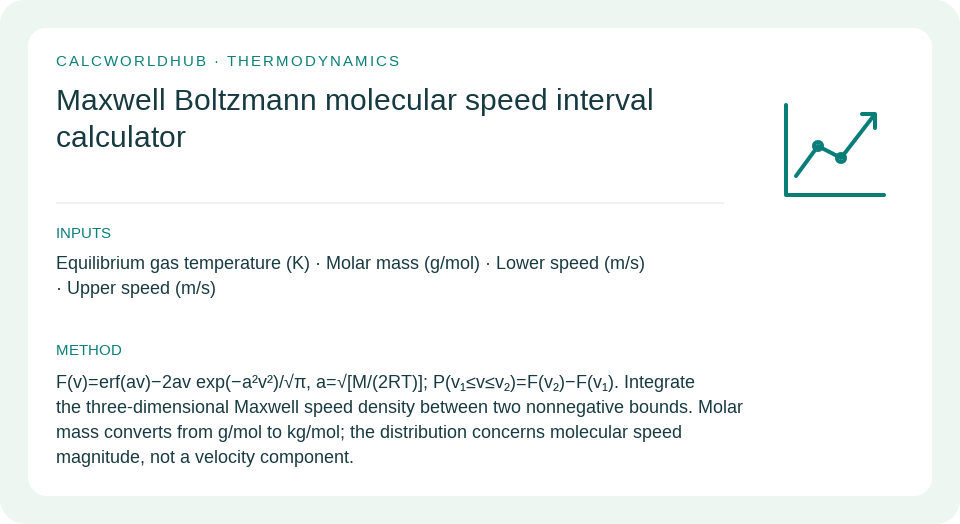
F(v)=erf(av)−2av exp(−a²v²)/√π, a=√[M/(2RT)]; P(v₁≤v≤v₂)=F(v₂)−F(v₁).
Integrate the three-dimensional Maxwell speed density between two nonnegative bounds. Molar mass converts from g/mol to kg/mol; the distribution concerns molecular speed magnitude, not a velocity component.
What to enter
T— Equilibrium gas temperature (K)- Equilibrium gas temperature (K). Enter the value for this state; the units shown are used without an unstated conversion.
M— Molar mass (g/mol)- Molar mass (g/mol). Enter the value for this state; the units shown are used without an unstated conversion.
v1— Lower speed (m/s)- Lower speed (m/s). Enter the value for this state; the units shown are used without an unstated conversion.
v2— Upper speed (m/s)- Upper speed (m/s). Enter the value for this state; the units shown are used without an unstated conversion.
Interpreting the result
Dilute classical equilibrium gas, no drift flow, quantum degeneracy or nonequilibrium beam. Error-function approximation limits the displayed population precision to approximately 10⁻⁵ percentage point.
Reading the outputs
Returns a percent population, the most probable speed and RMS speed in m/s.
Frequently asked questions
Does RMS speed mean every molecule moves that fast?
No. It is a distribution moment; the interval probability describes the population spread.
Are negative speeds allowed?
Speed is a nonnegative magnitude. A signed velocity-component distribution would be Gaussian instead.
Can I enter an arbitrarily narrow band?
Yes, but rounding and the error-function approximation limit meaningful tiny probability differences.
How do I use the Maxwell Boltzmann molecular speed interval calculator?
Enter Equilibrium gas temperature (K), Molar mass (g/mol), Lower speed (m/s), Upper speed (m/s). Match the units shown beside each field and review the result together with the assumptions below.
What is a worked example of Maxwell Boltzmann molecular speed interval?
Equilibrium gas temperature (K) = 300; Molar mass (g/mol) = 28.0134; Lower speed (m/s) = 200; Upper speed (m/s) = 600. Molecules within speed interval: 67.304558 % Most probable speed: 421.99743 m/s Root mean square speed: 516.839189 m/s For nitrogen-like molar mass 28.0134 g/mol at 300 K, 67.3046% of equilibrium molecules lie between 200 and 600 m/s. The 421.997 m/s most probable speed differs from the 516.839 m/s RMS value.
Read our calculation methodology.