Mean absolute error calculator
Measure the average absolute difference between paired observed and predicted values.
Calculator
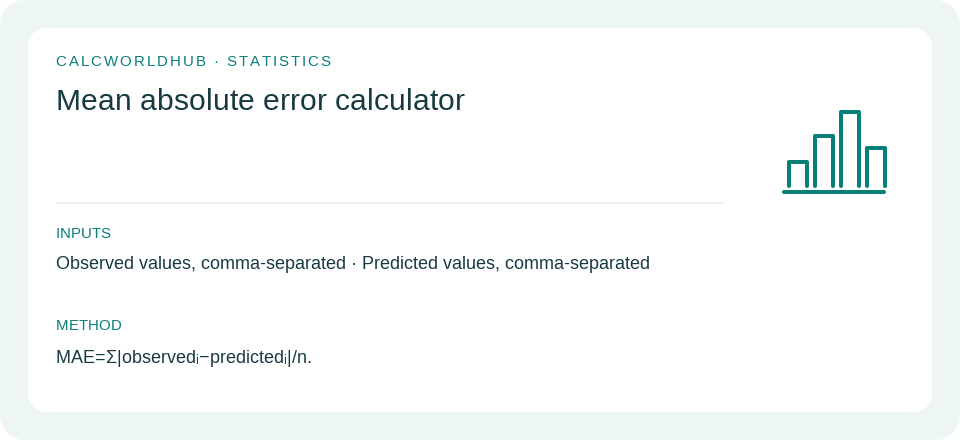
How to use this calculator
Measure the average absolute difference between paired observed and predicted values.
- Enter Observed values, comma-separated, Predicted values, comma-separated. Match the units shown beside each field and review the result together with the assumptions below.
- Read the worked example below to check the expected input format and result.
- Compare another scenario by changing one input at a time. Use Reset to return to the starting values.
Mean absolute error calculator
Measure the average absolute difference between paired observed and predicted values.
What it measures
Each prediction error is observed minus predicted. Taking absolute values prevents positive and negative errors from canceling before averaging.
Inputs and units
- Observed values, comma-separated: Observed values in their measurement units, comma-separated.
- Predicted values, comma-separated: Predictions in matching order and units; each item pairs with the same-position observation.
Formula and method
MAE=Σ|observedᵢ−predictedᵢ|/n.
Worked example
Observed 3,5,7,9 and predicted 2,6,6,10 have absolute errors 1,1,1,1, so MAE=1.
Interpreting the result
The result is in the same units as the measured variable. Lower MAE means smaller average absolute error on this sample, but it does not show error direction.
Assumptions and limits
Lists must have the same nonzero number of finite paired observations. The metric weights each pair equally and is sensitive to the scale of the data.
Frequently asked questions
Can overprediction and underprediction cancel?
No. Absolute errors are averaged, so opposite signs do not cancel.
Does MAE reveal bias direction?
No. Use signed errors or a bias statistic to see whether predictions tend high or low.
How do I use the Mean absolute error calculator?
Enter Observed values, comma-separated, Predicted values, comma-separated. Match the units shown beside each field and review the result together with the assumptions below.
What is a worked example of Mean absolute error?
Observed 3,5,7,9 and predicted 2,6,6,10 have absolute errors 1,1,1,1, so MAE=1.
What does the Mean absolute error calculator calculate?
Measure the average absolute difference between paired observed and predicted values.
See the calculation methodology.
Good calculators show their work.
CalcWorldHub is built around clear inputs and visible assumptions. Results are estimates for planning; check official sources or your provider’s terms when exact figures matter.