How to use this calculator
Turn a consecutive DAC code sweep into differential and endpoint integral nonlinearity, including a monotonicity check.
- Enter Ascending-code measured outputs (V). Match the units shown beside each field and review the result together with the assumptions below.
- Read the worked example below to check the expected input format and result.
- Compare another scenario by changing one input at a time. Use Reset to return to the starting values.
Measured DAC DNL and INL explained
A DAC sweep can be checked against the straight line joining its first and last measured code outputs. This endpoint convention removes measured offset and gain before calculating integral nonlinearity, while each actual code step supplies differential nonlinearity. Keep measurements in code order.
Inputs, symbols, and units
levels— Ascending-code measured outputs (V)- One measured output for each consecutive code, in code order; do not sort measurements. Use comma-separated values in the stated order.
Formula and method
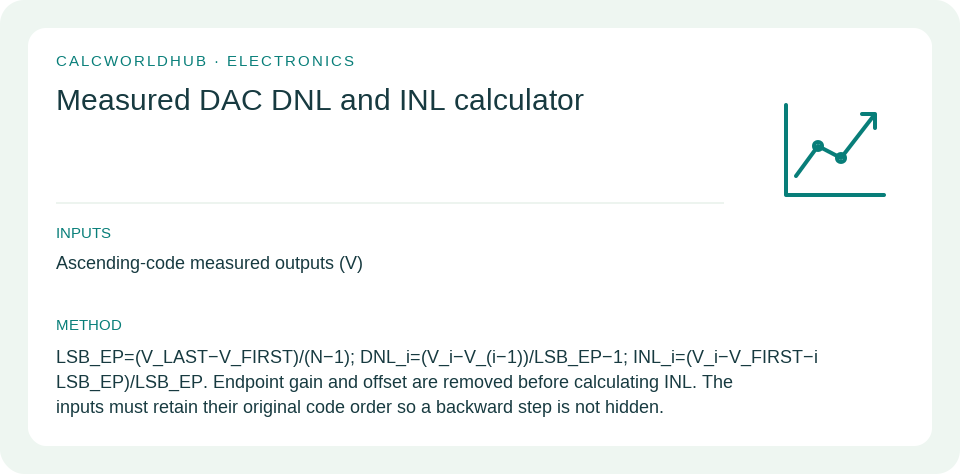
LSB_EP=(V_LAST−V_FIRST)/(N−1); DNL_i=(V_i−V_(i−1))/LSB_EP−1; INL_i=(V_i−V_FIRST−i LSB_EP)/LSB_EP.
Endpoint gain and offset are removed before calculating INL. The inputs must retain their original code order so a backward step is not hidden.
A worked scenario
Ascending-code measured outputs (V) = 0,0.251,0.498,0.752,1.001.
- Maximum absolute DNL: 0.014985 LSB
- Maximum endpoint INL: 0.00999 LSB
- Minimum code step: 0.247 V
Five outputs from 0 to 1.001 V are evaluated against their own endpoint line; the 0.498 V middle measurement reveals an INL departure.
Assumptions and edge cases
Consecutive sampled codes only; this is not a claim about unmeasured codes or a best-fit INL convention.
Reading the outputs
Maximum absolute DNL and INL are reported in endpoint LSB. A negative minimum step means the measured sweep is nonmonotonic.
Frequently asked questions
Should I sort the voltage list?
No. Sorting destroys the code-to-output relationship and can hide nonmonotonic behavior.
Is endpoint INL the same as best-fit INL?
No; a best-fit straight line may produce a different maximum residual.
Do I need every DAC code?
Only a full consecutive sweep measures every code transition; a partial sweep describes that segment.
How do I use the Measured DAC DNL and INL calculator?
Enter Ascending-code measured outputs (V). Match the units shown beside each field and review the result together with the assumptions below.
What is a worked example of Measured DAC DNL and INL?
Ascending-code measured outputs (V) = 0,0.251,0.498,0.752,1.001. Maximum absolute DNL: 0.014985 LSB Maximum endpoint INL: 0.00999 LSB Minimum code step: 0.247 V Five outputs from 0 to 1.001 V are evaluated against their own endpoint line; the 0.498 V middle measurement reveals an INL departure.
Background or definition reference: Analog Devices digital-to-analog converter nonlinearity.
Read our calculation methodology.