How to use this calculator
Compare geometric and arithmetic spectral averages to distinguish a peaky power profile from a flat one.
- Enter Positive spectral power bins. Match the units shown beside each field and review the result together with the assumptions below.
- Read the worked example below to check the expected input format and result.
- Compare another scenario by changing one input at a time. Use Reset to return to the starting values.
Measured spectrum flatness explained
This guide follows measured spectrum flatness calculator from its stated formula through a worked example, then identifies the assumptions that bound the result.
How the calculation works
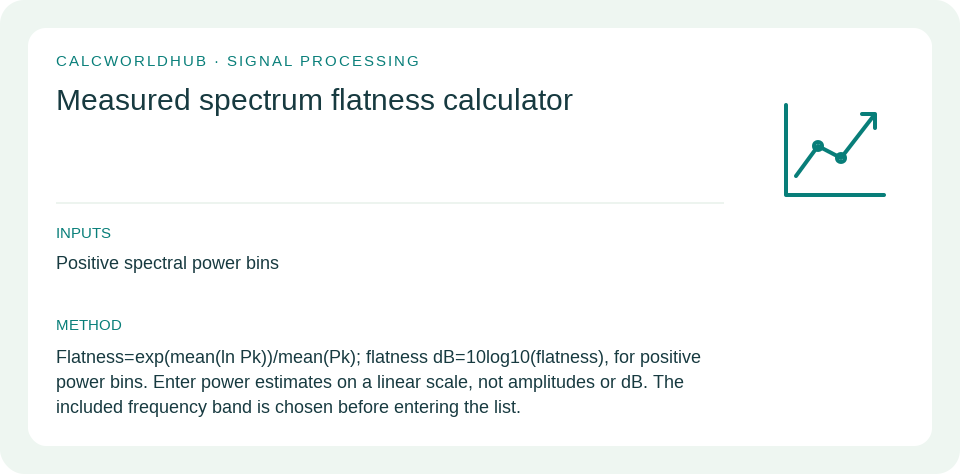
Flatness=exp(mean(ln Pk))/mean(Pk); flatness dB=10log10(flatness), for positive power bins.
Enter power estimates on a linear scale, not amplitudes or dB. The included frequency band is chosen before entering the list.
Set up the calculation
power— Positive spectral power bins- Strictly positive comparable power estimates; exclude bins intentionally omitted from analysis. Use comma-separated values in the stated order.
Limits of this model
Zero bins are rejected rather than silently replaced by a noise floor. Flatness alone cannot classify a sound as noise or tone.
Check this example
Positive spectral power bins = [1, 2, 3, 2, 1].
- Spectral flatness: 0.913195 ratio
- Spectral flatness in decibels: -0.394363 dB
- Arithmetic mean bin power: 1.8 entered power units
Powers [1,2,3,2,1] form a mildly peaked spectrum; their geometric mean is below their arithmetic mean.
Reading the outputs
A ratio of one is perfectly flat; increasingly negative decibels indicate stronger concentration.
Frequently asked questions
Can I paste decibel powers?
Convert each value back to linear power first.
Why are zero bins rejected?
Their logarithms are undefined; a chosen measurement floor changes the question.
Is an equal-power spectrum always noise?
No. Deterministic signals can also have flat finite spectra.
How do I use the Measured spectrum flatness calculator?
Enter Positive spectral power bins. Match the units shown beside each field and review the result together with the assumptions below.
What is a worked example of Measured spectrum flatness?
Positive spectral power bins = [1, 2, 3, 2, 1]. Spectral flatness: 0.913195 ratio Spectral flatness in decibels: -0.394363 dB Arithmetic mean bin power: 1.8 entered power units Powers [1,2,3,2,1] form a mildly peaked spectrum; their geometric mean is below their arithmetic mean.
Read our calculation methodology.