Michaelis constant from rate calculator
Solve for Km from substrate concentration, observed rate, and known Vmax. Enter your values below to see the result and method.
inputs.
Related calculators
These tools cover nearby questions while keeping this page focused on its own calculation.
How to use this calculator
Solve for Km from substrate concentration, observed rate, and known Vmax.
- Enter Substrate concentration [S] (μM), Observed rate v (μmol/min), Maximum rate Vmax (μmol/min). Match the units shown beside each field and review the result together with the assumptions below.
- Read the worked example below to check the expected input format and result.
- Compare another scenario by changing one input at a time. Use Reset to return to the starting values.
Match measurements to the assay conditions
Use this assay calculation to connect a measured rate or optical reading with an enzyme or solution quantity. Solve for Km from substrate concentration, observed rate, and known Vmax.
Inputs and units
Enter the values below for this model. Substrate concentration in micromolar under the same conditions as the measured and maximum rates. Measured reaction rate at the entered substrate concentration; it must be positive and below Vmax for this rearrangement. Saturation rate in μmol/min for the same assay conditions as the observed rate.
- Substrate concentration [S] (μM): Substrate concentration in micromolar under the same conditions as the measured and maximum rates.
- Observed rate v (μmol/min): Measured reaction rate at the entered substrate concentration; it must be positive and below Vmax for this rearrangement.
- Maximum rate Vmax (μmol/min): Saturation rate in μmol/min for the same assay conditions as the observed rate.
Assay equation and example
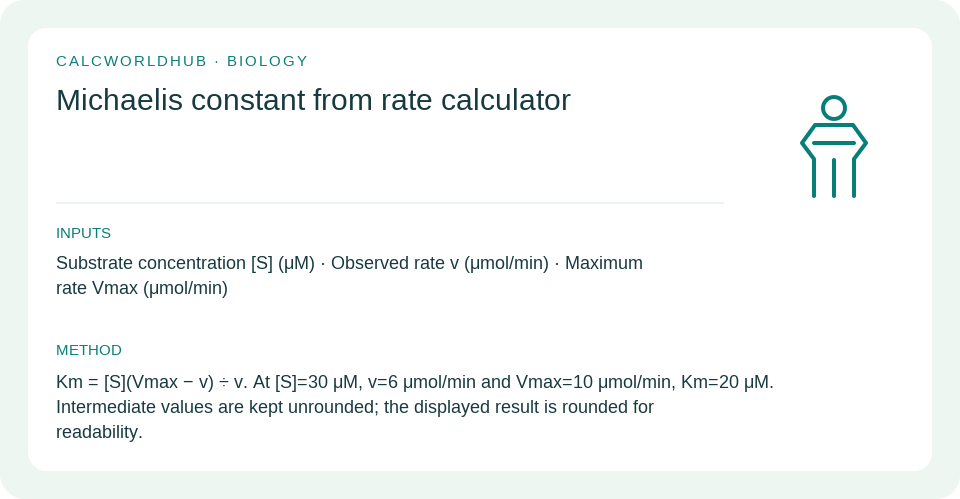
Km = [S](Vmax − v) ÷ v.
At [S]=30 μM, v=6 μmol/min and Vmax=10 μmol/min, Km=20 μM.
Intermediate values are kept unrounded; the displayed result is rounded for readability.
Check the experimental range
Keep blank correction, reaction volume, temperature, and units consistent with the assay that produced the input values. This arithmetic does not validate an assay protocol.
Assumptions and limitations
Requires 0<v<Vmax and a steady-state Michaelis–Menten assay; noise is amplified when v is very small.
Frequently asked questions
Why must the observed rate be below Vmax for this rearrangement?
Km = [S](Vmax − v) ÷ v. At [S]=30 μM, v=6 μmol/min and Vmax=10 μmol/min, Km=20 μM.
Which assumptions matter for this michaelis constant from rate?
Requires 0<v<Vmax and a steady-state Michaelis–Menten assay; noise is amplified when v is very small.
How do I use the Michaelis constant from rate calculator?
Enter Substrate concentration [S] (μM), Observed rate v (μmol/min), Maximum rate Vmax (μmol/min). Match the units shown beside each field and review the result together with the assumptions below.
What is a worked example of Michaelis constant from rate?
Km = [S](Vmax − v) ÷ v. At [S]=30 μM, v=6 μmol/min and Vmax=10 μmol/min, Km=20 μM. Intermediate values are kept unrounded; the displayed result is rounded for readability.
What does the Michaelis constant from rate calculator calculate?
Solve for Km from substrate concentration, observed rate, and known Vmax.
Read the calculation methodology and privacy policy.
Source: NCBI Assay Guidance Manual: Michaelis–Menten kinetics and Km.