Microbial exponential population projection calculator
Project population under a constant specific exponential growth rate.
Calculator
How to use this calculator
Project population under a constant specific exponential growth rate.
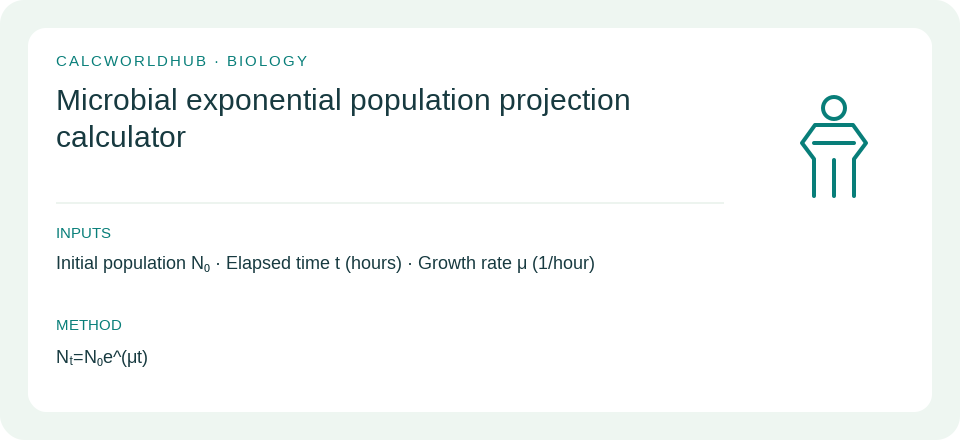
- Enter Initial population N₀, Elapsed time t (hours), Growth rate μ (1/hour). Match the units shown beside each field and review the result together with the assumptions below.
- Read the worked example below to check the expected input format and result.
- Compare another scenario by changing one input at a time. Use Reset to return to the starting values.
Microbial exponential population projection calculator
Project population under a constant specific exponential growth rate.
Inputs and units
- Initial population N₀: Population at the start of the interval; use a positive count for log-ratio calculations.
- Elapsed time t (hours): Time between the initial and final concentration measurements, using the time unit paired with k.
- Growth rate μ (1/hour): Specific growth rate μ per stated time unit; positive means growth and negative means decline.
Formula and method
Nₜ=N₀e^(μt)
Worked example
For N₀=1,000 cells, μ=0.231 h⁻¹, and t=6 h, Nₜ≈1,000e^1.386≈3,998.8 cells.
Interpreting the result
The result is a continuous model expectation and may be fractional; observed counts are discrete and biological limits can stop exponential growth.
Assumptions and limits
Initial population and time must be nonnegative; μ may be signed for growth or decline. Assumes constant specific rate and no carrying-capacity limit.
Sources and method
- Describes exponential microbial growth during log phase and its condition-dependent limits. OpenStax Microbiology: how microbes grow
Frequently asked questions
Which inputs determine this result?
The visible inputs are Initial population N₀, Elapsed time t (hours), Growth rate μ (1/hour). Each is used by the displayed formula; the calculator does not use any other hidden measurement.
When does this method apply?
Initial population and time must be nonnegative; μ may be signed for growth or decline. Assumes constant specific rate and no carrying-capacity limit.
How do I use the Microbial exponential population projection calculator?
Enter Initial population N₀, Elapsed time t (hours), Growth rate μ (1/hour). Match the units shown beside each field and review the result together with the assumptions below.
What is a worked example of Microbial exponential population projection?
For N₀=1,000 cells, μ=0.231 h⁻¹, and t=6 h, Nₜ≈1,000e^1.386≈3,998.8 cells.
What does the Microbial exponential population projection calculator calculate?
Project population under a constant specific exponential growth rate.
See the calculation methodology.
Good calculators show their work.
CalcWorldHub is built around clear inputs and visible assumptions. Results are estimates for planning; check official sources or your provider’s terms when exact figures matter.