How to use this calculator
Translate a cutting-speed and chip-load setup into spindle rpm, table feed, and volumetric removal rate.
- Enter Effective cutting diameter (mm), Cutting speed (m/min), Effective teeth, Feed per tooth (mm), then complete the remaining labeled fields. Match the units shown beside each field and review the result together with the assumptions below.
- Read the worked example below to check the expected input format and result.
- Compare another scenario by changing one input at a time. Use Reset to return to the starting values.
Milling spindle feed and removal rate explained
Material removal rate combines feed with axial and radial engagement; it is a geometric estimate and does not account for machine limits or tool deflection.
Inputs, symbols, and units
d— Effective cutting diameter (mm)- Effective cutting diameter (mm).
v— Cutting speed (m/min)- Cutting speed (m/min).
z— Effective teeth- Effective teeth. Enter a whole number.
f— Feed per tooth (mm)- Feed per tooth (mm).
ap— Axial depth (mm)- Axial depth (mm).
ae— Radial engagement (mm)- Radial engagement (mm).
Formula and method
v*1000/(pi*d)
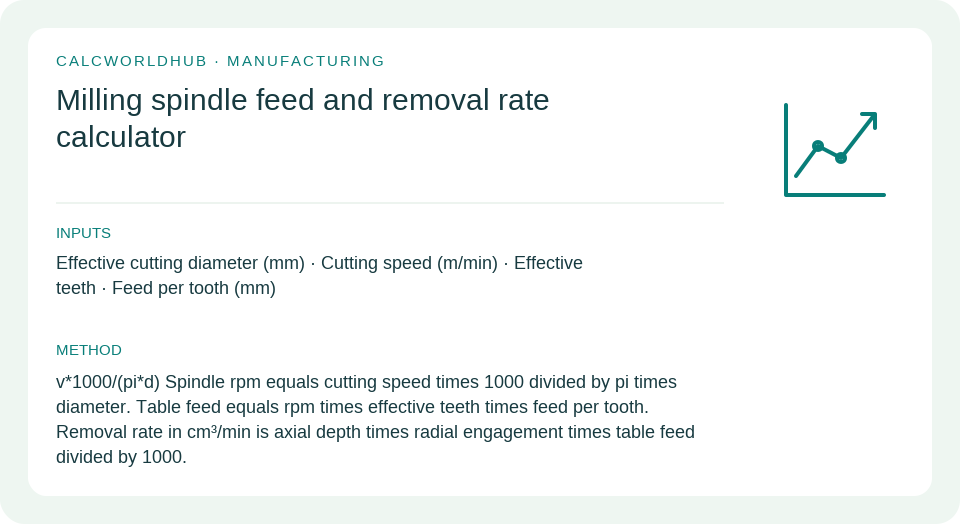
Spindle rpm equals cutting speed times 1000 divided by pi times diameter. Table feed equals rpm times effective teeth times feed per tooth. Removal rate in cm³/min is axial depth times radial engagement times table feed divided by 1000.
A worked scenario
Effective cutting diameter (mm) = 20; Cutting speed (m/min) = 100; Effective teeth = 4; Feed per tooth (mm) = 0.05; Axial depth (mm) = 2; Radial engagement (mm) = 10.
- Spindle speed: 1591.549431 rpm
- Table feed: 318.309886 mm/min
- Material removal rate: 6.366198 cm³/min
The specified 20 mm effective diameter and 100 m/min cutting speed give 1591.549431 rpm. Four teeth at 0.05 mm/tooth then produce 318.309886 mm/min feed.
Assumptions and edge cases
Geometric planning only; machine limits, radial chip thinning, stability, and tool/material recommendations are not selected automatically.
Frequently asked questions
Which diameter is needed?
The effective cutting diameter for the operation.
Are all physical teeth always effective?
No, enter the number appropriate to the cutting model.
Does calculated feed prove a safe cut?
No, verify the actual tooling and machine conditions.
How do I use the Milling spindle feed and removal rate calculator?
Enter Effective cutting diameter (mm), Cutting speed (m/min), Effective teeth, Feed per tooth (mm), then complete the remaining labeled fields. Match the units shown beside each field and review the result together with the assumptions below.
What is a worked example of Milling spindle feed and removal rate?
Effective cutting diameter (mm) = 20; Cutting speed (m/min) = 100; Effective teeth = 4; Feed per tooth (mm) = 0.05; Axial depth (mm) = 2; Radial engagement (mm) = 10. Spindle speed: 1591.549431 rpm Table feed: 318.309886 mm/min Material removal rate: 6.366198 cm³/min The specified 20 mm effective diameter and 100 m/min cutting speed give 1591.549431 rpm. Four teeth at 0.05 mm/tooth then produce 318.309886 mm/min feed.
Method reference: Sandvik Coromant milling formulas.
Read our calculation methodology.