How to use this calculator
Plan an unconstrained point-to-point move that minimizes squared acceleration over a specified deadline.
- Enter Initial position (m), Initial speed (m/s), Final position (m), Final speed (m/s), then complete the remaining labeled fields. Match the units shown beside each field and review the result together with the assumptions below.
- Read the worked example below to check the expected input format and result.
- Compare another scenario by changing one input at a time. Use Reset to return to the starting values.
Minimum energy double integrator transfer explained
How the calculation works
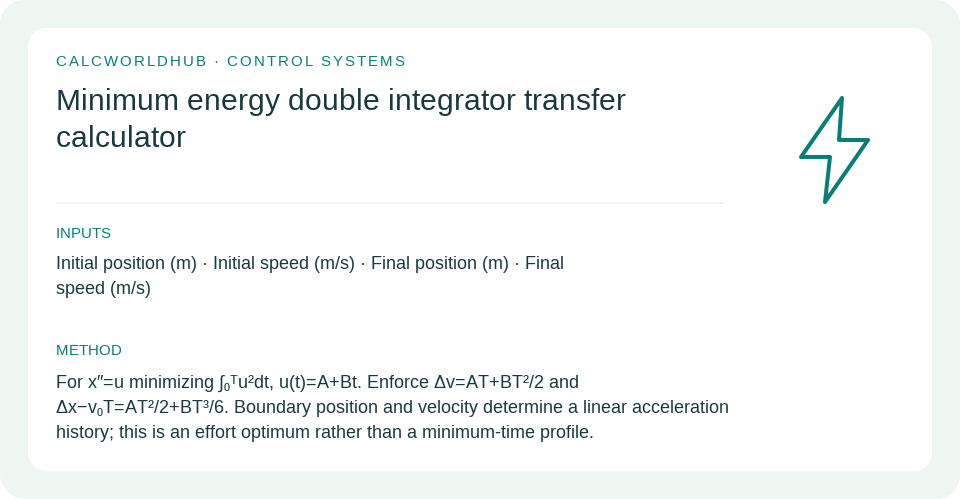
For x″=u minimizing ∫₀ᵀu²dt, u(t)=A+Bt. Enforce Δv=AT+BT²/2 and Δx−v₀T=AT²/2+BT³/6.
Boundary position and velocity determine a linear acceleration history; this is an effort optimum rather than a minimum-time profile.
Set up the calculation
x0— Initial position (m)- Position at time zero.
v0— Initial speed (m/s)- Initial signed velocity.
xf— Final position (m)- Required position at the deadline.
vf— Final speed (m/s)- Required final velocity.
T— Transfer time (s)- Fixed positive deadline.
Limits of this model
No acceleration, speed or jerk limits. A constrained motion planner is needed when these outputs exceed machine limits.
Check this example
Initial position (m) = 0; Initial speed (m/s) = 0.4; Final position (m) = 3; Final speed (m/s) = 0; Transfer time (s) = 4.
- Integrated acceleration squared: 0.9475 m²/s³
- Initial acceleration: 0.725 m/s²
- Final acceleration: -0.925 m/s²
Move from zero to three metres in four seconds, starting at 0.4 m/s and ending at rest.
Reading the outputs
Integrated acceleration squared measures effort; endpoint accelerations reveal whether actuator bounds may be exceeded.
Frequently asked questions
Is this the fastest possible move?
No. The deadline is an input, and effort is minimized within it.
Can the trajectory initially move backward?
Yes, depending on the endpoint conditions.
Why report endpoint accelerations?
A linear acceleration reaches its largest absolute value at an endpoint.
How do I use the Minimum energy double integrator transfer calculator?
Enter Initial position (m), Initial speed (m/s), Final position (m), Final speed (m/s), then complete the remaining labeled fields. Match the units shown beside each field and review the result together with the assumptions below.
What is a worked example of Minimum energy double integrator transfer?
Initial position (m) = 0; Initial speed (m/s) = 0.4; Final position (m) = 3; Final speed (m/s) = 0; Transfer time (s) = 4. Integrated acceleration squared: 0.9475 m²/s³ Initial acceleration: 0.725 m/s² Final acceleration: -0.925 m/s² Move from zero to three metres in four seconds, starting at 0.4 m/s and ending at rest.
Read our calculation methodology.