How to use this calculator
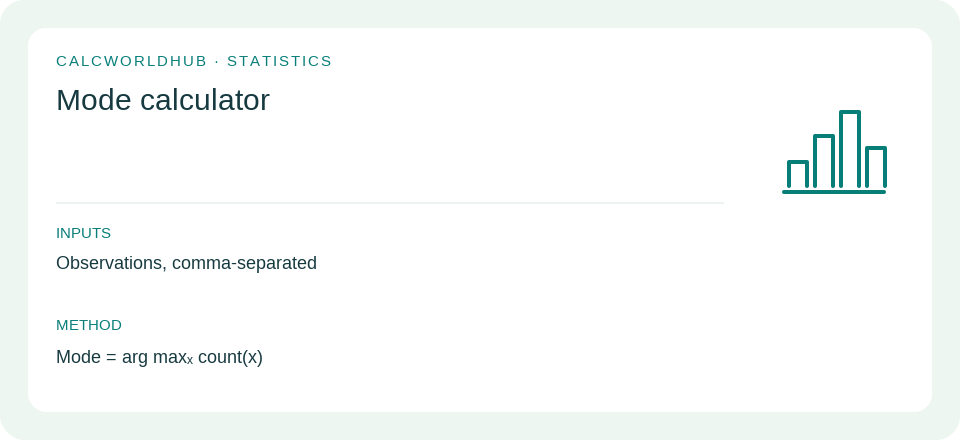
Return the value or values that occur most often in the supplied numeric observations. Ties are preserved rather than broken arbitrarily.
- Enter Observations, comma-separated. Match the units shown beside each field and review the result together with the assumptions below.
- Read the worked example below to check the expected input format and result.
- Compare another scenario by changing one input at a time. Use Reset to return to the starting values.
How Mode calculator works
Return the value or values that occur most often in the supplied numeric observations. Ties are preserved rather than broken arbitrarily.
Inputs and units
- Observations, comma-separated: At least one finite observation; repeated values count toward frequency.
Formula and method
Mode = arg maxₓ count(x)
Worked example
In [4,7,7,10,12], the mode is 7; in [1,1,2,2], both 1 and 2 are modes.
Interpreting the result
A list can have one mode, several tied modes, or no repeated value; the calculator reports all most-frequent values.
Assumptions and limits
Numeric equality is exact after parsing. For continuous measurements, binning or a density estimate is usually more meaningful than exact repeated values.
Sources and method
- The mode is a descriptive measure defined by the most frequent value(s). OpenStax measures of center
Frequently asked questions
Can data have two modes?
Yes. When two or more values share the highest frequency, all are returned.
What if every value occurs once?
There is no uniquely repeated mode; the page should identify the tie rather than choose one value.
How do I use the Mode calculator?
Enter Observations, comma-separated. Match the units shown beside each field and review the result together with the assumptions below.
What is a worked example of Mode?
In [4,7,7,10,12], the mode is 7; in [1,1,2,2], both 1 and 2 are modes.
What does the Mode calculator calculate?
Return the value or values that occur most often in the supplied numeric observations. Ties are preserved rather than broken arbitrarily.