Molar enthalpy from measured heat calculator
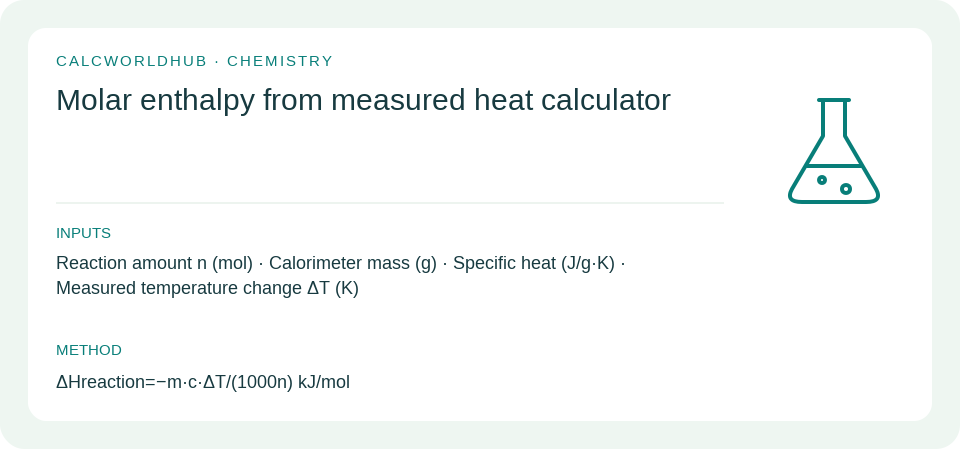
Estimate reaction molar enthalpy from the heat absorbed by a calorimeter and the reacted amount.
Calculator
How to use this calculator
Estimate reaction molar enthalpy from the heat absorbed by a calorimeter and the reacted amount.
- Enter Reaction amount n (mol), Calorimeter mass (g), Specific heat (J/g·K), Measured temperature change ΔT (K). Match the units shown beside each field and review the result together with the assumptions below.
- Read the worked example below to check the expected input format and result.
- Compare another scenario by changing one input at a time. Use Reset to return to the starting values.
Molar enthalpy from measured heat calculator
Estimate reaction molar enthalpy from the heat absorbed by a calorimeter and the reacted amount.
Inputs and units
- Reaction amount n (mol): Reacted amount in moles; the molar enthalpy is reported per mole on this same reaction basis.
- Calorimeter mass (g): Mass exchanging heat with the reaction, in grams; the simple model omits extra calorimeter heat capacity.
- Specific heat (J/g·K): Heat capacity per gram and kelvin for the material represented by the mass input.
- Measured temperature change ΔT (K): Final minus initial temperature in kelvins; retain the sign because warming or cooling determines heat direction.
Formula and method
ΔHreaction=−m·c·ΔT/(1000n) kJ/mol
Worked example
For m=100 g, c=4.18 J g⁻¹ K⁻¹, ΔT=5 K, n=2 mol: qsolution=2,090 J, so ΔH=−1.045 kJ/mol.
Interpreting the result
The negative sign follows qreaction=−qsurroundings; a warming calorimeter implies an exothermic reaction under the stated setup.
Assumptions and limits
Reacted amount must be positive; mass and specific heat nonnegative. Assumes negligible calorimeter heat capacity beyond the supplied mass and no heat loss.
Sources and method
- Provides q=mcΔT; the reaction heat sign is opposite the surroundings’ heat. OpenStax Chemistry 2e: thermochemistry equations
Frequently asked questions
Which inputs determine this result?
The visible inputs are Reaction amount n (mol), Calorimeter mass (g), Specific heat (J/g·K), Measured temperature change ΔT (K). Each is used by the displayed formula; the calculator does not use any other hidden measurement.
When does this method apply?
Reacted amount must be positive; mass and specific heat nonnegative. Assumes negligible calorimeter heat capacity beyond the supplied mass and no heat loss.
How do I use the Molar enthalpy from measured heat calculator?
Enter Reaction amount n (mol), Calorimeter mass (g), Specific heat (J/g·K), Measured temperature change ΔT (K). Match the units shown beside each field and review the result together with the assumptions below.
What is a worked example of Molar enthalpy from measured heat?
For m=100 g, c=4.18 J g⁻¹ K⁻¹, ΔT=5 K, n=2 mol: qsolution=2,090 J, so ΔH=−1.045 kJ/mol.
What does the Molar enthalpy from measured heat calculator calculate?
Estimate reaction molar enthalpy from the heat absorbed by a calorimeter and the reacted amount.
See the calculation methodology.
Good calculators show their work.
CalcWorldHub is built around clear inputs and visible assumptions. Results are estimates for planning; check official sources or your provider’s terms when exact figures matter.