How to use this calculator
Compare two species-abundance samples with the Morisita-Horn similarity index.
- Enter Sample A species counts, Sample B species counts. Match the units shown beside each field and review the result together with the assumptions below.
- Read the worked example below to check the expected input format and result.
- Compare another scenario by changing one input at a time. Use Reset to return to the starting values.
How this calculation works
Morisita-Horn compares relative-abundance profiles while adjusting the shared-species overlap by each sample’s concentration. Values range from zero for no shared abundance to one for identical relative composition.
Inputs and units
sampleAAbundances— Sample A species counts- Enter nonnegative integer counts for each species, in a fixed order.
sampleBAbundances— Sample B species counts- Enter counts for the same species in exactly the same order.
Formula
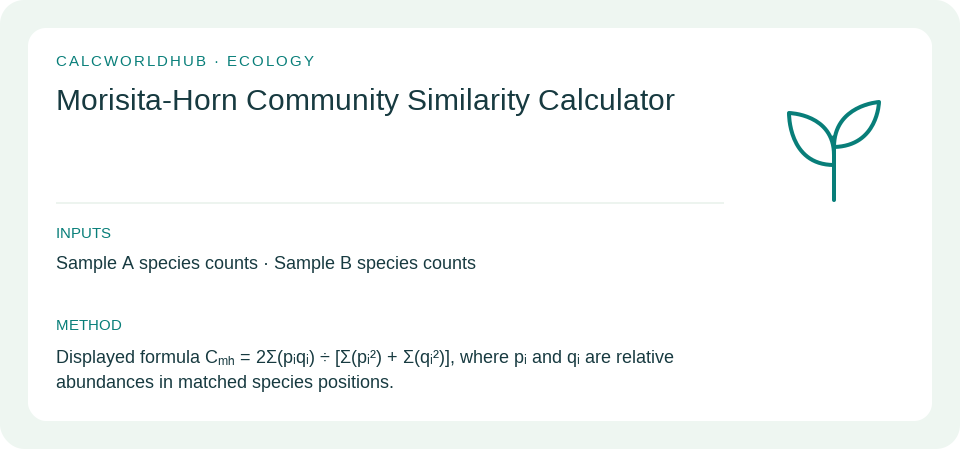
Cₘₕ = 2Σ(pᵢqᵢ) ÷ [Σ(pᵢ²) + Σ(qᵢ²)], where pᵢ and qᵢ are relative abundances in matched species positions.
Method
Enter two aligned abundance lists in the same species order. Zero counts are allowed; each sample must contain at least one individual.
Worked example
Counts of 10, 20, 30 and 15, 15, 30 give a Morisita-Horn similarity of 0.9818.
Assumptions and limits
The index compares observed abundance profiles and does not estimate unseen species or account for imperfect detection.
Frequently asked questions
What does a value of 1 mean?
The two samples have identical relative species-abundance profiles.
Can sample totals differ?
Yes. The index uses relative abundances, so totals may differ between samples.
Do the lists need matching order?
Yes. Each position must refer to the same species in both samples.
How do I use the Morisita-Horn Community Similarity Calculator?
Enter Sample A species counts, Sample B species counts. Match the units shown beside each field and review the result together with the assumptions below.
What is a worked example of Morisita-Horn Community Similarity?
Counts of 10, 20, 30 and 15, 15, 30 give a Morisita-Horn similarity of 0.9818.
Reference: CRAN abdiv documentation for the Horn-Morisita abundance similarity index. See our calculation methodology.