How to use this calculator
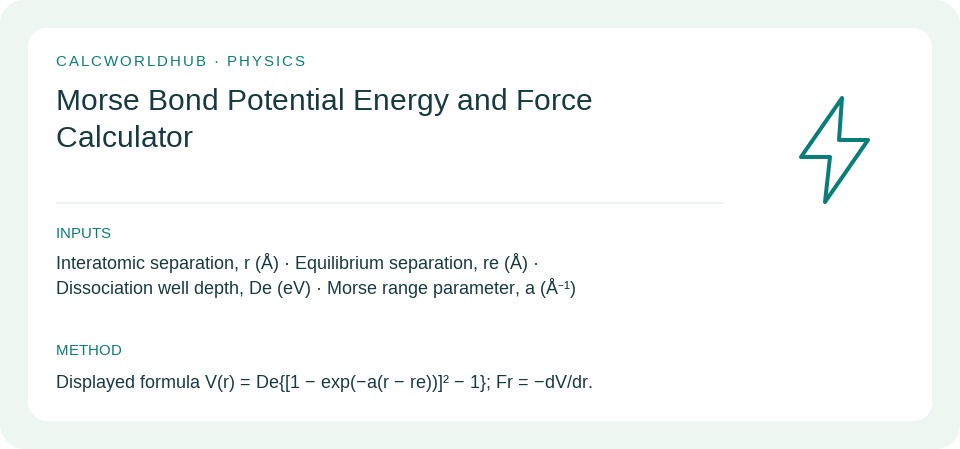
Evaluate a diatomic-bond Morse potential energy and radial force from its four model parameters.
- Enter Interatomic separation, r (Å), Equilibrium separation, re (Å), Dissociation well depth, De (eV), Morse range parameter, a (Å⁻¹). Match the units shown beside each field and review the result together with the assumptions below.
- Read the worked example below to check the expected input format and result.
- Compare another scenario by changing one input at a time. Use Reset to return to the starting values.
How this calculation works
The Morse potential is an anharmonic model for a diatomic bond. With dissociation set to zero energy, the well minimum is −De at the equilibrium separation, and the model approaches zero as the atoms separate.
Inputs and units
separation— Interatomic separation, r (Å)- Current distance between the two atoms.
equilibriumSeparation— Equilibrium separation, re (Å)- Bond length at the potential minimum.
wellDepth— Dissociation well depth, De (eV)- Positive depth between the minimum and dissociation energy.
rangeParameter— Morse range parameter, a (Å⁻¹)- Positive inverse-length parameter controlling well width.
Formula
V(r) = De{[1 − exp(−a(r − re))]² − 1}; Fr = −dV/dr.
Method
Evaluate the exponential bond potential at the entered separation and differentiate it with respect to radial separation to obtain the force on the second atom.
Worked example
For De = 5 eV, a = 2 Å⁻¹, re = 1 Å, and r = 1.25 Å, the Morse energy is −4.22591 eV and radial force is −4.77302 eV/Å.
Assumptions and limits
This is a one-dimensional Morse model with user-supplied parameters and the dissociation-zero energy convention. It does not fit a molecule or include rotation, neighboring bonds, or electronic structure.
Frequently asked questions
Where is the potential minimum?
At r = re, where the energy is −De and radial force is zero.
Why can the force be negative?
The force is defined as −dV/dr; above equilibrium it points back toward shorter separation.
Does the Morse potential describe every bond exactly?
No. It is a model potential whose parameters must match the molecule and purpose of the calculation.
How do I use the Morse Bond Potential Energy and Force Calculator?
Enter Interatomic separation, r (Å), Equilibrium separation, re (Å), Dissociation well depth, De (eV), Morse range parameter, a (Å⁻¹). Match the units shown beside each field and review the result together with the assumptions below.
What is a worked example of Morse Bond Potential Energy and Force?
For De = 5 eV, a = 2 Å⁻¹, re = 1 Å, and r = 1.25 Å, the Morse energy is −4.22591 eV and radial force is −4.77302 eV/Å.
Reference: Philip M. Morse’s original diatomic-molecule potential paper. See our calculation methodology.