How to use this calculator
Compare remaining mortgage payments with a new fixed-rate loan and estimate the payment break-even after closing costs.
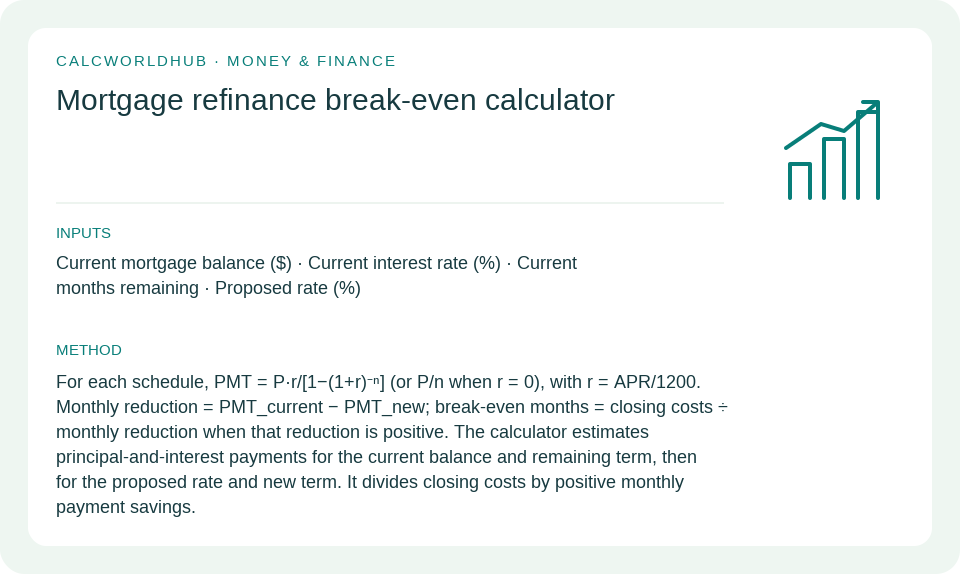
- Enter Current mortgage balance ($), Current interest rate (%), Current months remaining, Proposed rate (%), then complete the remaining labeled fields. Match the units shown beside each field and review the result together with the assumptions below.
- Read the worked example below to check the expected input format and result.
- Compare another scenario by changing one input at a time. Use Reset to return to the starting values.
How this estimate works
A refinance changes the rate and often the term. This comparison keeps the remaining current schedule separate from the proposed new schedule.
Inputs and units
balance— Current mortgage balance ($)- Enter the remaining principal, not the original loan amount.
currentApr— Current interest rate (%)- Rate for the remaining existing loan.
remainingMonths— Current months remaining- Number of payments left on the current mortgage.
newApr— Proposed rate (%)- Rate for the refinance offer.
newTermMonths— New loan term (months)- Term of the proposed new loan.
closingCosts— Estimated closing costs ($)- Enter costs paid upfront or financed separately.
Formula and method
For each schedule, PMT = P·r/[1−(1+r)⁻ⁿ] (or P/n when r = 0), with r = APR/1200. Monthly reduction = PMT_current − PMT_new; break-even months = closing costs ÷ monthly reduction when that reduction is positive.
The calculator estimates principal-and-interest payments for the current balance and remaining term, then for the proposed rate and new term. It divides closing costs by positive monthly payment savings.
Worked example
For a $250,000 balance with 240 months left at 6.5%, a new 5.75% rate over 240 months reduces modeled principal-and-interest payments by about $108.72. With $4,000 closing costs, payment break-even is about 36.8 months.
Assumptions and limits
This is a cash-flow estimate, not a loan recommendation. It excludes taxes, insurance, escrow changes, points rolled into the new loan, tax effects, prepayment penalties, and the opportunity cost of cash. A longer new term can lower payment while increasing total interest.
Frequently asked questions
Does a lower monthly payment guarantee savings?
No. A longer new term can reduce each payment while increasing the total scheduled payments.
Are closing costs financed into the new balance?
This version treats costs as an upfront amount in the break-even calculation. Add financed costs to the proposed principal for a full comparison.
Does the result include taxes and insurance?
No. It compares principal and interest only.
How do I use the Mortgage refinance break-even calculator?
Enter Current mortgage balance ($), Current interest rate (%), Current months remaining, Proposed rate (%), then complete the remaining labeled fields. Match the units shown beside each field and review the result together with the assumptions below.
What is a worked example of Mortgage refinance break-even?
For a $250,000 balance with 240 months left at 6.5%, a new 5.75% rate over 240 months reduces modeled principal-and-interest payments by about $108.72. With $4,000 closing costs, payment break-even is about 36.8 months.
Read our calculation methodology.