How to use this calculator
Free Negative predictive value calculator. Estimate the share of negative test results that are true negatives from prevalence and test accuracy.
- Enter Prior probability (%), Sensitivity (%), Specificity (%). Match the units shown beside each field and review the result together with the assumptions below.
- Read the worked example below to check the expected input format and result.
- Compare another scenario by changing one input at a time. Use Reset to return to the starting values.
What a negative result means depends on prevalence
Negative predictive value (NPV) is the share of negative test results that come from people who do not have the condition. It combines prior probability with sensitivity and specificity for a defined population and test.
Inputs for this calculation
- Prior probability (%): Enter the chance of the condition before the result is known in the population you are assessing.
- Sensitivity (%): Among people who have the condition, the fraction expected to test positive.
- Specificity (%): Among people without the condition, the fraction expected to test negative.
Formula and method
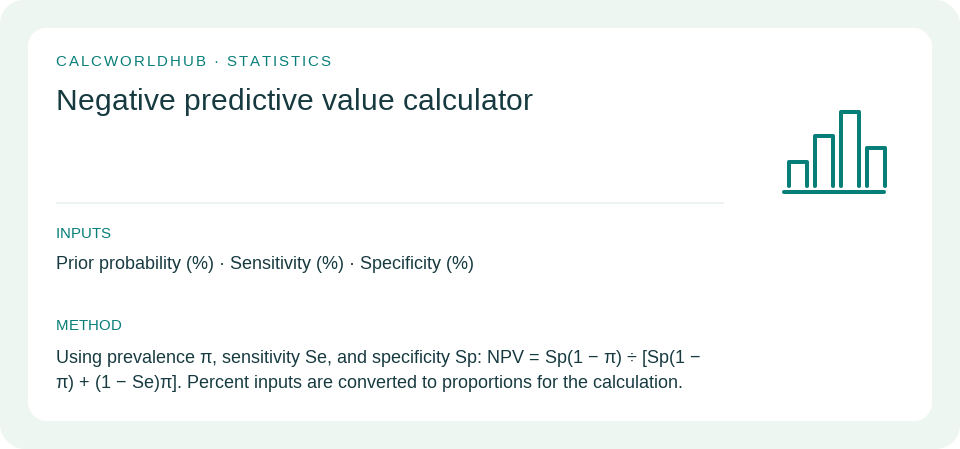
Using prevalence π, sensitivity Se, and specificity Sp: NPV = Sp(1 − π) ÷ [Sp(1 − π) + (1 − Se)π]. Percent inputs are converted to proportions for the calculation.
Worked example
For prevalence 10%, sensitivity 90%, and specificity 95%, imagine 10,000 people from that population: 1,000 have the condition, leaving 100 false negatives; among 9,000 without it, 8,550 are true negatives. NPV = 8,550 ÷ (8,550 + 100) = 98.84%.
Reading the result
The result estimates the probability of no condition among negative results under those supplied rates. It is not the same quantity as specificity, which is calculated among people known not to have the condition.
Assumptions and limits
Changing prevalence changes NPV even when sensitivity and specificity stay constant. This calculator cannot establish whether the input rates fit an individual patient; it is not a diagnosis or a substitute for clinical interpretation.
Method references
Frequently asked questions
Does a high NPV rule out a condition for one person?
No. It is a population-level predictive value based on the supplied prevalence and test characteristics. Individual symptoms, timing, and clinical judgment can change what a result means.
How do I use the Negative predictive value calculator?
Enter Prior probability (%), Sensitivity (%), Specificity (%). Match the units shown beside each field and review the result together with the assumptions below.
What is a worked example of Negative predictive value?
For prevalence 10%, sensitivity 90%, and specificity 95%, imagine 10,000 people from that population: 1,000 have the condition, leaving 100 false negatives; among 9,000 without it, 8,550 are true negatives. NPV = 8,550 ÷ (8,550 + 100) = 98.84%.
What does the Negative predictive value calculator calculate?
Free Negative predictive value calculator. Estimate the share of negative test results that are true negatives from prevalence and test accuracy.
What assumptions apply to Negative predictive value?
Changing prevalence changes NPV even when sensitivity and specificity stay constant. This calculator cannot establish whether the input rates fit an individual patient; it is not a diagnosis or a substitute for clinical interpretation.