Net gray surface radiation calculator
Estimate net thermal radiation exchange between a gray surface and uniform surroundings.
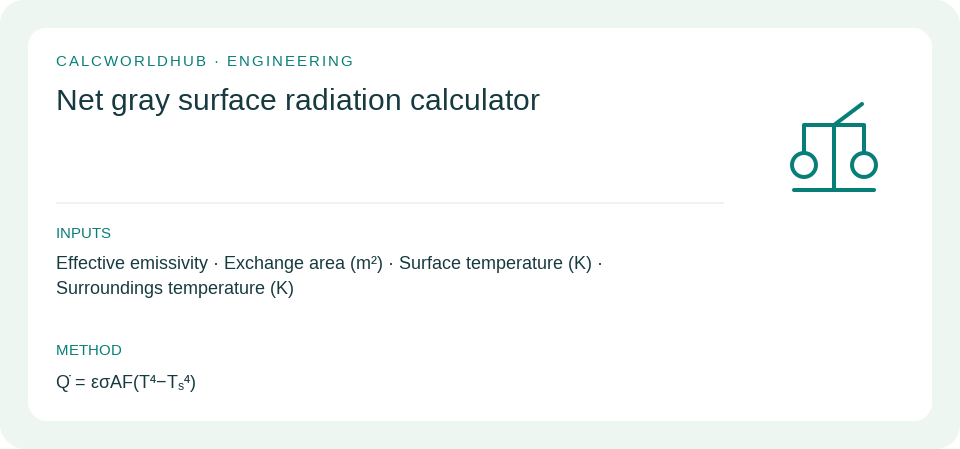
How to use this calculator
Estimate net thermal radiation exchange between a gray surface and uniform surroundings.
- Enter Effective emissivity, Exchange area (m²), Surface temperature (K), Surroundings temperature (K), then complete the remaining labeled fields. Match the units shown beside each field and review the result together with the assumptions below.
- Read the worked example below to check the expected input format and result.
- Compare another scenario by changing one input at a time. Use Reset to return to the starting values.
Net gray surface radiation calculator
Estimate net thermal radiation exchange between a gray surface and uniform surroundings.
Inputs and units
- Effective emissivity: Dimensionless surface emissivity between zero and one for the relevant temperature range and wavelength band.
- Exchange area (m²): Radiating surface area in square metres, not total enclosure area unless the surface is the entire exposed area.
- Surface temperature (K): Absolute surface temperature in kelvins; use a fourth-power radiation law only with absolute temperature.
- Surroundings temperature (K): Effective absolute radiative temperature of the surroundings in kelvins.
- Effective view factor: Fractional geometric coupling from the surface toward the modeled surroundings, between zero and one.
Formula and method
Q̇ = εσAF(T⁴−Tₛ⁴)
Worked example
With ε=0.8, A=2 m², F=1, T=500 K, Tₛ=300 K, Q̇=0.8σ·2(500⁴−300⁴)≈4,935.5 W.
Interpreting the result
Positive output means the surface loses net radiative heat to cooler surroundings; negative means net radiative gain.
Assumptions and limits
Temperatures are absolute kelvins, area nonnegative, emissivity and view factor between 0 and 1. Assumes gray diffuse behavior and one effective surrounding temperature; convection and conduction are separate.
Sources and method
- States the Stefan–Boltzmann dependence on emissivity, area, and absolute temperature and explains net exchange with surroundings. OpenStax College Physics 2e: radiation
Frequently asked questions
What does this net gray surface radiation result tell me?
Positive output means the surface loses net radiative heat to cooler surroundings; negative means net radiative gain.
What assumptions should I check?
Temperatures are absolute kelvins, area nonnegative, emissivity and view factor between 0 and 1. Assumes gray diffuse behavior and one effective surrounding temperature; convection and conduction are separate.
How do I use the Net gray surface radiation calculator?
Enter Effective emissivity, Exchange area (m²), Surface temperature (K), Surroundings temperature (K), then complete the remaining labeled fields. Match the units shown beside each field and review the result together with the assumptions below.
What is a worked example of Net gray surface radiation?
With ε=0.8, A=2 m², F=1, T=500 K, Tₛ=300 K, Q̇=0.8σ·2(500⁴−300⁴)≈4,935.5 W.
What does the Net gray surface radiation calculator calculate?
Estimate net thermal radiation exchange between a gray surface and uniform surroundings.
See the calculation methodology.