How to use this calculator
Estimate the number of people who would need treatment to prevent one additional adverse outcome over a specified follow-up period.
- Enter Control risk (0–1), Treatment risk (0–1). Match the units shown beside each field and review the result together with the assumptions below.
- Read the worked example below to check the expected input format and result.
- Compare another scenario by changing one input at a time. Use Reset to return to the starting values.
How Number needed to treat from risk difference works
Estimate the number of people who would need treatment to prevent one additional adverse outcome over a specified follow-up period.
Inputs and units
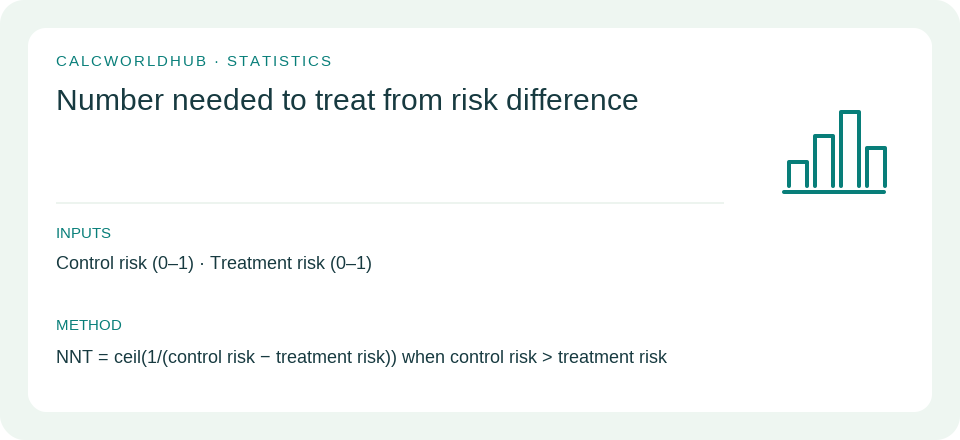
- Control risk (0–1): Enter the adverse-outcome risk in the control group as a proportion from 0 to 1.
- Treatment risk (0–1): Enter the corresponding adverse-outcome risk in the treatment group over the same follow-up period.
Formula and method
NNT = ceil(1/(control risk − treatment risk)) when control risk > treatment risk
Worked example
If control risk is 0.20 and treatment risk is 0.15, the absolute risk reduction is 0.05. The reciprocal is 20, so NNT = 20 over that study's follow-up period.
Interpreting the result
An NNT of 20 means about 20 people would need the intervention for one fewer adverse outcome, given these risks and this time horizon.
Assumptions and limits
The calculator requires a beneficial absolute risk reduction. Equal risks give no finite NNT; increased treatment risk is harm and should be described with a number needed to harm instead. Estimates inherit study uncertainty and population differences.
Sources and method
- Absolute risk differences and number needed to treat. Cochrane Handbook: effect measures
Frequently asked questions
Why must the outcome risks use the same follow-up period?
The risk difference is meaningful only when both groups are measured over comparable time horizons.
What if treatment risk is higher than control risk?
That is an increase in harm, not a beneficial NNT; report the absolute risk increase or number needed to harm instead.
How do I use the Number needed to treat from risk difference?
Enter Control risk (0–1), Treatment risk (0–1). Match the units shown beside each field and review the result together with the assumptions below.
What is a worked example of Number needed to treat from risk difference?
If control risk is 0.20 and treatment risk is 0.15, the absolute risk reduction is 0.05. The reciprocal is 20, so NNT = 20 over that study's follow-up period.
What does the Number needed to treat from risk difference calculate?
Estimate the number of people who would need treatment to prevent one additional adverse outcome over a specified follow-up period.