How to use this calculator
Estimate a band-limited signal’s minimum sample rate and add a chosen oversampling margin.
- Enter Highest frequency of interest, Oversampling factor. Match the units shown beside each field and review the result together with the assumptions below.
- Read the worked example below to check the expected input format and result.
- Compare another scenario by changing one input at a time. Use Reset to return to the starting values.
How this calculation works
Sampling-rate planning starts with the highest frequency that must be represented. The Nyquist limit gives an ideal lower bound for a low-pass, band-limited signal; a practical design can increase that rate to leave room for the transition band of an analog anti-alias filter.
Inputs and units
highestFrequency— Highest frequency of interest- Upper frequency to preserve, in hertz (Hz).
oversamplingFactor— Oversampling factor- Multiplier applied to the theoretical minimum; enter 1 for the Nyquist bound or a larger factor for margin.
Formula
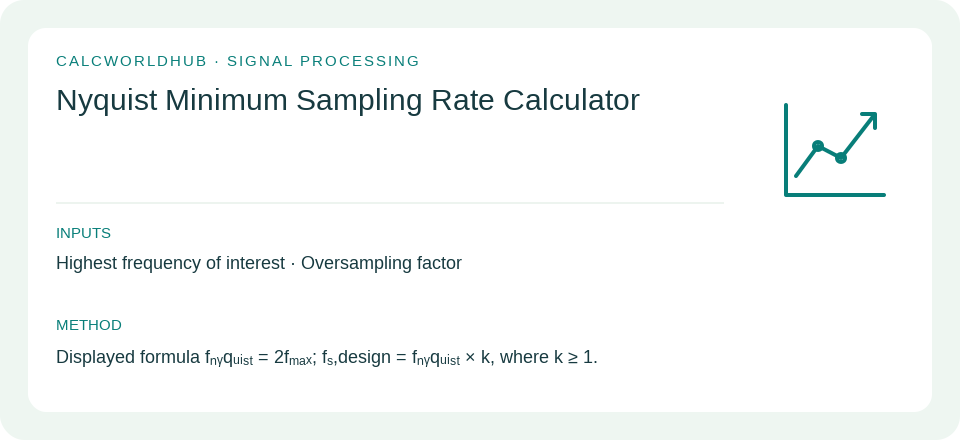
fₙᵧqᵤᵢₛₜ = 2fₘₐₓ; fₛ,design = fₙᵧqᵤᵢₛₜ × k, where k ≥ 1.
Method
Enter the highest frequency fₘₐₓ in hertz and an oversampling factor k. The theoretical Nyquist minimum is twice that frequency. The design rate multiplies the minimum by k; k = 1 is only the ideal bound, while a larger factor adds margin. Results are in samples per second (Hz).
Worked example
For a highest frequency of 20,000 Hz and an oversampling factor of 1.25, the theoretical minimum is 40,000 samples/s and the selected design rate is 50,000 samples/s.
Assumptions and limits
This assumes a low-pass signal whose relevant spectrum extends from near DC through the entered highest frequency and is band-limited before digitization. A real analog anti-alias filter needs a transition band, so the ideal minimum alone may not be enough. Band-pass undersampling and converter-specific limits are outside this estimate.
Frequently asked questions
Why is the minimum rate twice the highest frequency?
For a band-limited low-pass signal, the Nyquist criterion sets the sampling frequency at at least twice the maximum frequency under ideal conditions.
Is exactly twice the frequency a practical sampling rate?
It is an ideal boundary. Real analog filters need a transition band, so designers often choose a higher rate and verify converter and filter specifications.
Can this be used for a band-pass signal?
Not directly. Band-pass sampling depends on bandwidth, frequency placement, and alias zones; this tool assumes a low-pass spectrum starting near DC.
How do I use the Nyquist Minimum Sampling Rate Calculator?
Enter Highest frequency of interest, Oversampling factor. Match the units shown beside each field and review the result together with the assumptions below.
What is a worked example of Nyquist Minimum Sampling Rate?
For a highest frequency of 20,000 Hz and an oversampling factor of 1.25, the theoretical minimum is 40,000 samples/s and the selected design rate is 50,000 samples/s.
Reference: National Instruments sampling theorem and anti-alias filter guidance. See our calculation methodology.