How to use this calculator
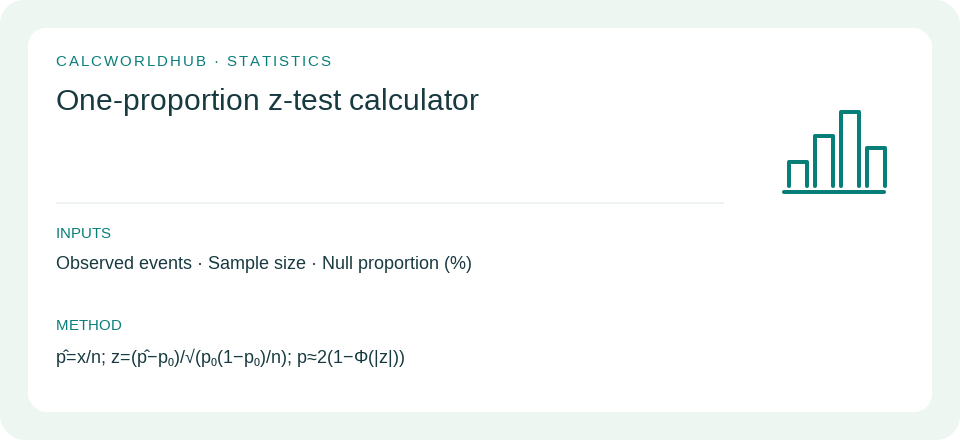
Compare an observed event proportion with a null proportion using the one-sample z statistic and a normal-approximation two-sided p-value.
- Enter Observed events, Sample size, Null proportion (%). Match the units shown beside each field and review the result together with the assumptions below.
- Read the worked example below to check the expected input format and result.
- Compare another scenario by changing one input at a time. Use Reset to return to the starting values.
How One-proportion z-test calculator works
Compare an observed event proportion with a null proportion using the one-sample z statistic and a normal-approximation two-sided p-value.
Inputs and units
- Observed events: Observed count x of events; enter a whole number between zero and the sample size.
- Sample size: Number of independent trials n; it must be a positive whole number and at least x.
- Null proportion (%): Null proportion p₀ as a percent from 0 to 100, not a 0–1 fraction.
Formula and method
p̂=x/n; z=(p̂−p₀)/√(p₀(1−p₀)/n); p≈2(1−Φ(|z|))
Worked example
For 60 events in 100 trials against p₀=0.50, p̂=0.60, SE₀=0.05, and z=2; the approximate two-sided p-value is 0.0455.
Interpreting the result
The z statistic is measured in null standard errors. The p-value is a tail probability assuming the null and the test model; it is not the probability that the null is true.
Assumptions and limits
Events must be an integer from 0 to n and n must be positive. The normal approximation can be poor when n p₀ or n(1−p₀) is small; no continuity correction is applied.
Sources and method
- Normal density, cumulative function, parameters, and model context. NIST/SEMATECH e-Handbook, Normal Distribution
Frequently asked questions
What does the p-value mean?
It is the approximate chance, under the null model, of a z statistic at least as extreme in either direction.
Is this an exact binomial test?
No. It uses a normal approximation and does not apply a continuity correction.
How do I use the One-proportion z-test calculator?
Enter Observed events, Sample size, Null proportion (%). Match the units shown beside each field and review the result together with the assumptions below.
What is a worked example of One-proportion z-test?
For 60 events in 100 trials against p₀=0.50, p̂=0.60, SE₀=0.05, and z=2; the approximate two-sided p-value is 0.0455.
What does the One-proportion z-test calculator calculate?
Compare an observed event proportion with a null proportion using the one-sample z statistic and a normal-approximation two-sided p-value.