How to use this calculator
Construct the finite taper with the greatest fraction of frequency energy inside a specified baseband interval.
- Enter Taper length, Half bandwidth (cycles/sample). Match the units shown beside each field and review the result together with the assumptions below.
- Read the worked example below to check the expected input format and result.
- Compare another scenario by changing one input at a time. Use Reset to return to the starting values.
Optimal band concentrated DPSS taper explained
A DPSS taper is the unit-energy vector that maximizes the fraction of its discrete-time spectral energy inside the selected frequency band. The principal concentration eigenvalue is the reported in-band fraction; the time-bandwidth product is N·W.
Inputs, symbols, and units
n— Taper length- Number of discrete taper samples. Enter a whole number.
W— Half bandwidth (cycles/sample)- Positive normalized half bandwidth below 0.5.
Formula and method
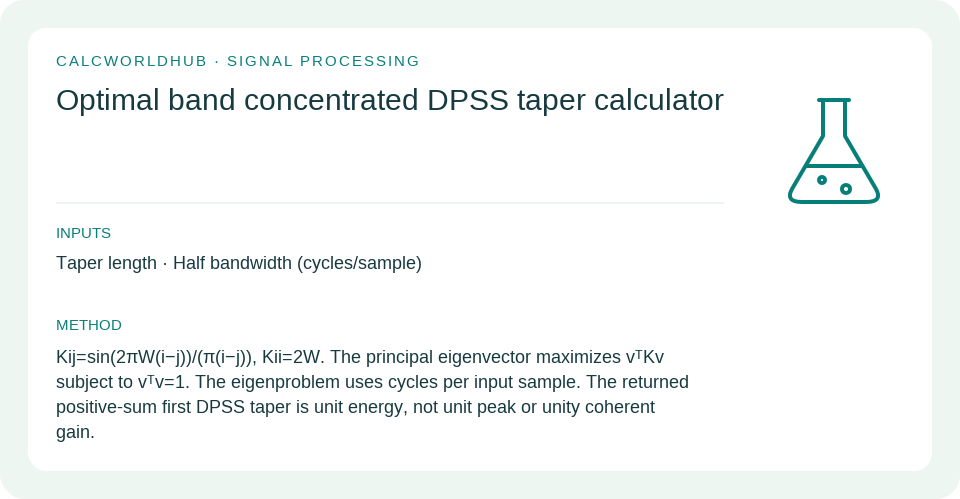
Kij=sin(2πW(i−j))/(π(i−j)), Kii=2W. The principal eigenvector maximizes vᵀKv subject to vᵀv=1.
The eigenproblem uses cycles per input sample. The returned positive-sum first DPSS taper is unit energy, not unit peak or unity coherent gain.
A worked scenario
Taper length = 8; Half bandwidth (cycles/sample) = 0.1.
- Maximum energy concentration: 0.948453 ratio
- Time bandwidth product: 0.8 NW
- Unit-energy taper 0: 0.220392 ratio
- Unit-energy taper 1: 0.317934 ratio
- Unit-energy taper 2: 0.396195 ratio
- Unit-energy taper 3: 0.439745 ratio
- Unit-energy taper 4: 0.439745 ratio
- Unit-energy taper 5: 0.396195 ratio
- Unit-energy taper 6: 0.317934 ratio
- Unit-energy taper 7: 0.220392 ratio
Eight taper samples and half bandwidth 0.1 cycles/sample create a time-bandwidth product of 0.8.
Assumptions and edge cases
Only the first taper is returned. At very large bandwidth concentration eigenvalues cluster, making the maximizing vector poorly determined numerically.
Reading the outputs
Concentration is the achieved in-band energy fraction; every normalized taper sample is exposed.
Frequently asked questions
Is W measured in hertz?
No. Divide a hertz half bandwidth by the sample rate before entry.
Why not normalize the peak to one?
Unit energy gives the eigenproblem its direct concentration interpretation.
Is this a complete multitaper PSD?
No. It constructs one taper, without processing a signal or averaging spectra.
How do I use the Optimal band concentrated DPSS taper calculator?
Enter Taper length, Half bandwidth (cycles/sample). Match the units shown beside each field and review the result together with the assumptions below.
What is a worked example of Optimal band concentrated DPSS taper?
Taper length = 8; Half bandwidth (cycles/sample) = 0.1. Maximum energy concentration: 0.948453 ratio Time bandwidth product: 0.8 NW Unit-energy taper 0: 0.220392 ratio Unit-energy taper 1: 0.317934 ratio Unit-energy taper 2: 0.396195 ratio Unit-energy taper 3: 0.439745 ratio Unit-energy taper 4: 0.439745 ratio Unit-energy taper 5: 0.396195 ratio Unit-energy taper 6: 0.317934 ratio Unit-energy taper 7: 0.220392 ratio Eight taper samples and half bandwidth 0.1 cycles/sample create a time-bandwidth product of 0.8.
Background or definition reference: SciPy discrete prolate spheroidal sequences.
Read our calculation methodology.