How to use this calculator
Select the intermediate pressure that minimizes two-stage ideal-gas compressor work with complete intercooling.
- Enter Initial absolute pressure (kPa), Final absolute pressure (kPa), Each stage inlet temperature (K), Heat capacity ratio, then complete the remaining labeled fields. Match the units shown beside each field and review the result together with the assumptions below.
- Read the worked example below to check the expected input format and result.
- Compare another scenario by changing one input at a time. Use Reset to return to the starting values.
Optimal two-stage compression with perfect intercooling explained
With equal stage efficiencies and perfect intercooling, the minimum-work pressure split is geometric.
How the calculation works
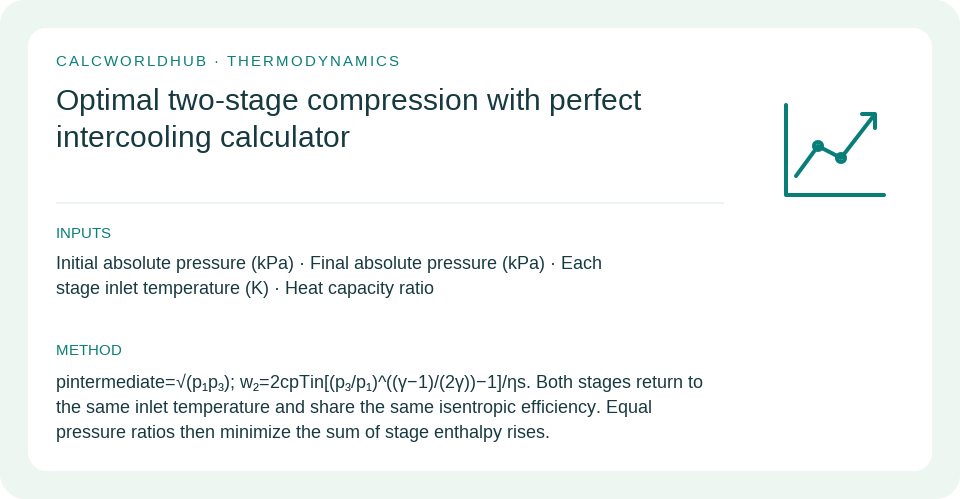
pintermediate=√(p₁p₃); w₂=2cpTin[(p₃/p₁)^((γ−1)/(2γ))−1]/ηs.
Both stages return to the same inlet temperature and share the same isentropic efficiency. Equal pressure ratios then minimize the sum of stage enthalpy rises.
Set up the calculation
p1— Initial absolute pressure (kPa)- Initial absolute pressure (kPa). Enter the value for this state; the units shown are used without an unstated conversion.
p3— Final absolute pressure (kPa)- Final absolute pressure (kPa). Enter the value for this state; the units shown are used without an unstated conversion.
T— Each stage inlet temperature (K)- Each stage inlet temperature (K). Enter the value for this state; the units shown are used without an unstated conversion.
g— Heat capacity ratio- Heat capacity ratio. Enter the value for this state; the units shown are used without an unstated conversion.
cp— Specific heat cp (kJ/kg/K)- Specific heat cp (kJ/kg/K). Enter the value for this state; the units shown are used without an unstated conversion.
eta— Stage isentropic efficiency- Stage isentropic efficiency. Enter the value for this state; the units shown are used without an unstated conversion.
Limits of this model
No intercooler pressure drop, unequal efficiencies, condensation or temperature-dependent cp. Those effects shift the optimum.
Check this example
Initial absolute pressure (kPa) = 100; Final absolute pressure (kPa) = 1600; Each stage inlet temperature (K) = 300; Heat capacity ratio = 1.4; Specific heat cp (kJ/kg/K) = 1.005; Stage isentropic efficiency = 0.85.
- Optimal intermediate pressure: 400 kPa
- Two-stage specific work: 344.770066 kJ/kg
- Work saved versus one stage: 19.549292 %
Compressing from 100 to 1,600 kPa in two equal-efficiency stages with perfect return to 300 K gives an optimal intermediate pressure of 400 kPa. Required specific work is 344.770 kJ/kg, 19.5493% below the comparable single-stage model.
Reading the outputs
Intermediate pressure is absolute kPa; work is kJ/kg and savings compare with one stage at the same inlet temperature and efficiency.
Frequently asked questions
Must both stage pressure ratios be equal?
Only under the equal-temperature, equal-efficiency assumptions on this page.
Is intercooler heat included in shaft work?
It is rejected heat, not shaft work; cooling-system electricity is excluded.
Why compare against a single stage?
It makes the effect of intercooling explicit at the same overall pressure ratio.
How do I use the Optimal two-stage compression with perfect intercooling calculator?
Enter Initial absolute pressure (kPa), Final absolute pressure (kPa), Each stage inlet temperature (K), Heat capacity ratio, then complete the remaining labeled fields. Match the units shown beside each field and review the result together with the assumptions below.
What is a worked example of Optimal two-stage compression with perfect intercooling?
Initial absolute pressure (kPa) = 100; Final absolute pressure (kPa) = 1600; Each stage inlet temperature (K) = 300; Heat capacity ratio = 1.4; Specific heat cp (kJ/kg/K) = 1.005; Stage isentropic efficiency = 0.85. Optimal intermediate pressure: 400 kPa Two-stage specific work: 344.770066 kJ/kg Work saved versus one stage: 19.549292 % Compressing from 100 to 1,600 kPa in two equal-efficiency stages with perfect return to 300 K gives an optimal intermediate pressure of 400 kPa. Required specific work is 344.770 kJ/kg, 19.5493% below the comparable single-stage model.
Background or definition reference: NASA Glenn ideal gas compression and expansion.
Read our calculation methodology.