Orbital speed from vis-viva equation calculator
Find speed at an orbital radius given the orbit semi-major axis and central gravitational parameter. Enter your values below to see the result and method.
inputs.
Related calculators
How to use this calculator
Find speed at an orbital radius given the orbit semi-major axis and central gravitational parameter.
- Enter Orbital radius r (m), Semi-major axis a (m), Gravitational parameter μ (m³/s²). Match the units shown beside each field and review the result together with the assumptions below.
- Read the worked example below to check the expected input format and result.
- Compare another scenario by changing one input at a time. Use Reset to return to the starting values.
Set the orbit and reference body
Use the two-body energy relation to estimate orbital speed from current radius, semi-major axis, and the central body’s gravitational parameter.
Inputs and units
- Orbital radius r (m):Current distance from the central body’s center, in metres.
- Semi-major axis a (m):Half the orbit ellipse’s major axis, in metres.
- Gravitational parameter μ (m³/s²):GM for the central body, in SI units.
Orbital equation and worked example
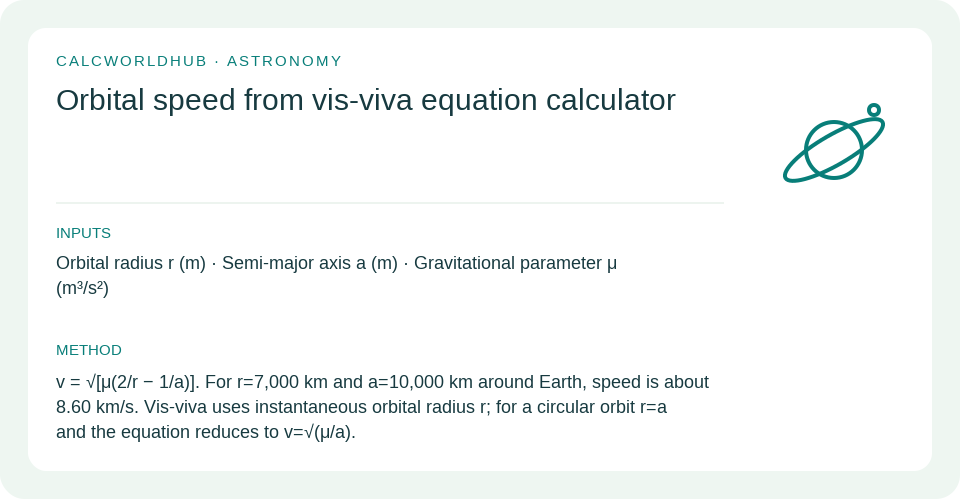
v = √[μ(2/r − 1/a)].
For r=7,000 km and a=10,000 km around Earth, speed is about 8.60 km/s.
Vis-viva uses instantaneous orbital radius r; for a circular orbit r=a and the equation reduces to v=√(μ/a).
How to interpret the orbit result
Measure r from the central body’s focus and use its μ=GM; this two-body equation omits perturbing bodies and nonspherical gravity.
Assumptions and limitations
Requires a bound orbit with 2/r − 1/a ≥ 0; μ and lengths must use SI units.
Source and method
NASA uses the vis-viva relation to connect speed, orbital radius, semi-major axis, and gravitational parameter. NASA Technical Reports Server — Orbit equations.
Frequently asked questions
Which values are needed for the orbital speed from vis-viva equation?
Enter current orbital radius r, semi-major axis a, and μ=GM for the central body. Use metres and m³/s² consistently.
Does this orbital speed from vis-viva equation include real-world effects?
No. It assumes an ideal two-body orbit and omits perturbations, nonspherical gravity, and atmospheric drag.
When is circular-orbit speed the simpler calculation?
For a circular orbit r=a, vis-viva reduces to v=√(μ/r). Use this page when the orbit is elliptical or when current radius differs from the semi-major axis.
How do I use the Orbital speed from vis-viva equation calculator?
Enter Orbital radius r (m), Semi-major axis a (m), Gravitational parameter μ (m³/s²). Match the units shown beside each field and review the result together with the assumptions below.
What is a worked example of Orbital speed from vis-viva equation?
v = √[μ(2/r − 1/a)]. For r=7,000 km and a=10,000 km around Earth, speed is about 8.60 km/s. Vis-viva uses instantaneous orbital radius r; for a circular orbit r=a and the equation reduces to v=√(μ/a).
Read the calculation methodology and privacy policy.