Osmotic pressure calculator
Estimate osmotic pressure from solution molarity and absolute temperature. Enter your values below to see the result and method.
inputs.
Related calculators
These tools cover nearby questions while keeping this page focused on its own calculation.
How to use this calculator
Free Osmotic pressure calculator. Estimate osmotic pressure from solution molarity and absolute temperature. Formula, example, and assumptions explained.
- Enter Van’t Hoff factor i, Molarity (mol/L), Temperature (K). Match the units shown beside each field and review the result together with the assumptions below.
- Read the worked example below to check the expected input format and result.
- Compare another scenario by changing one input at a time. Use Reset to return to the starting values.
Set the chemical conditions and units
Estimate osmotic pressure from solution molarity and absolute temperature.
Inputs and units
Enter the values below for this model. Effective number of dissolved particles per formula unit; use an appropriate effective value for dissociation and non-ideality. Solute concentration in mol/L; this van’t Hoff estimate assumes a dilute solution and an effective particle factor i. Absolute thermodynamic temperature in kelvins; Celsius values must be converted before use.
- Van’t Hoff factor i: Effective number of dissolved particles per formula unit; use an appropriate effective value for dissociation and non-ideality.
- Molarity (mol/L): Solute concentration in mol/L; this van’t Hoff estimate assumes a dilute solution and an effective particle factor i.
- Temperature (K): Absolute thermodynamic temperature in kelvins; Celsius values must be converted before use.
Equation and worked example
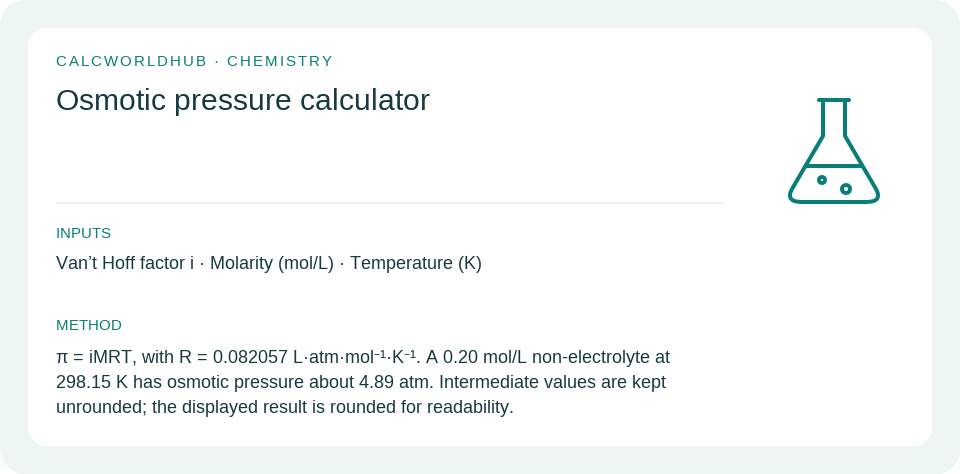
π = iMRT, with R = 0.082057 L·atm·mol⁻¹·K⁻¹.
A 0.20 mol/L non-electrolyte at 298.15 K has osmotic pressure about 4.89 atm.
Intermediate values are kept unrounded; the displayed result is rounded for readability.
Using the result
This is the ideal dilute-solution van ’t Hoff estimate; concentration-dependent interactions can change the effective particle contribution. Confirm concentration, temperature, and parameter conventions before comparing it with laboratory data.
Assumptions and limitations
Ideal dilute-solution estimate; dissociation and non-ideal interactions affect the effective Van’t Hoff factor.
Frequently asked questions
How does the effective particle factor change osmotic pressure?
π = iMRT, with R = 0.082057 L·atm·mol⁻¹·K⁻¹. A 0.20 mol/L non-electrolyte at 298.15 K has osmotic pressure about 4.89 atm.
When does the van ’t Hoff osmotic-pressure estimate break down?
Only to the extent stated here. Ideal dilute-solution estimate; dissociation and non-ideal interactions affect the effective Van’t Hoff factor.
How do I use the Osmotic pressure calculator?
Enter Van’t Hoff factor i, Molarity (mol/L), Temperature (K). Match the units shown beside each field and review the result together with the assumptions below.
What is a worked example of Osmotic pressure?
π = iMRT, with R = 0.082057 L·atm·mol⁻¹·K⁻¹. A 0.20 mol/L non-electrolyte at 298.15 K has osmotic pressure about 4.89 atm. Intermediate values are kept unrounded; the displayed result is rounded for readability.
What does the Osmotic pressure calculator calculate?
Free Osmotic pressure calculator. Estimate osmotic pressure from solution molarity and absolute temperature. Formula, example, and assumptions explained.
Read the calculation methodology and privacy policy.
Source: OpenStax Chemistry 2e: Colligative Properties and Osmotic Pressure.