Overall equipment effectiveness calculator
Separate equipment effectiveness into availability, speed performance, and quality yield.
inputs.
Calculator
How to use this calculator
Calculate OEE from planned time, operating time, ideal cycle time, total output, and good output.
- Enter Planned production time (min), Operating time (min), Ideal cycle time (min/unit), Total units produced, then complete the remaining labeled fields. Match the units shown beside each field and review the result together with the assumptions below.
- Read the worked example below to check the expected input format and result.
- Compare another scenario by changing one input at a time. Use Reset to return to the starting values.
Break OEE into availability, performance, and quality
Overall equipment effectiveness combines time available for production, speed against an ideal cycle, and the share of output that meets quality requirements. The factors help show where losses enter the selected shift or run.
Inputs and units
- Planned production time (min): Time scheduled for production in the period.
- Operating time (min): Planned time remaining after downtime under your chosen definition.
- Ideal cycle time (min/unit): The fastest sustainable cycle used as the production reference.
- Total units produced: All units made during the operating time.
- Good units produced: Units accepted without rework under the selected quality definition.
Formula and method
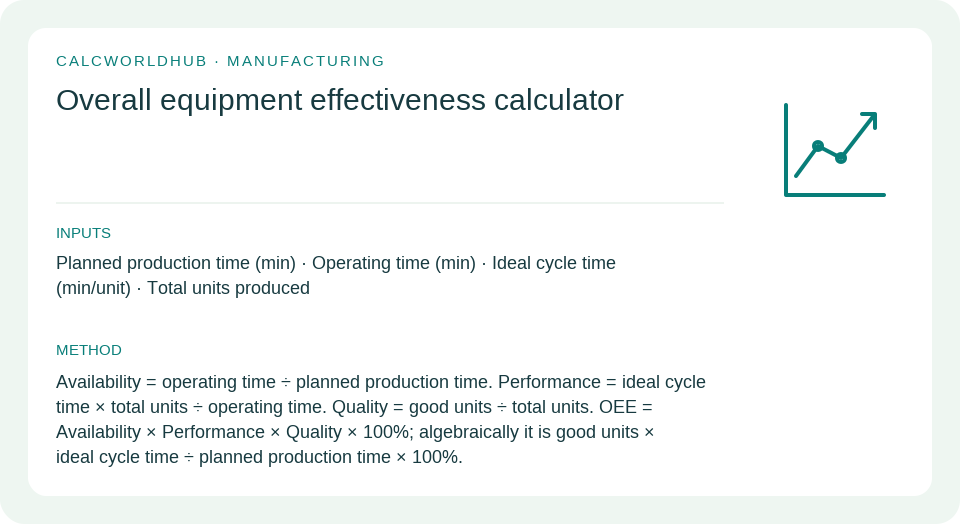
Availability = operating time ÷ planned production time. Performance = ideal cycle time × total units ÷ operating time. Quality = good units ÷ total units. OEE = Availability × Performance × Quality × 100%; algebraically it is good units × ideal cycle time ÷ planned production time × 100%.
Worked example
With 480 planned minutes and 420 operating minutes, availability is 420/480 = 87.5%. At 0.5 min/unit and 760 units, performance is 0.5×760/420 ≈ 90.476%. Quality is 730/760 ≈ 96.053%. Their product is 76.0417% OEE.
Interpreting the result
The modeled period produced good units equivalent to about 76.04% of the theoretical output at the entered ideal cycle for all planned time. Compare the three factors separately to locate the largest measured loss.
Assumptions and limits
Choose consistent boundaries for planned time, downtime, ideal cycle, and good output. Different plants may define planned production time and quality differently. An unrealistic ideal cycle or mismatched reporting window can make performance exceed 100% or make comparisons misleading.
Method references
Frequently asked questions
Why multiply the three factors instead of averaging them?
OEE treats each factor as a sequential share of planned production time: availability × speed performance × good-output share. An arithmetic average would not represent that combined proportion.
How do I use the Overall equipment effectiveness calculator?
Enter Planned production time (min), Operating time (min), Ideal cycle time (min/unit), Total units produced, then complete the remaining labeled fields. Match the units shown beside each field and review the result together with the assumptions below.
What is a worked example of Overall equipment effectiveness?
With 480 planned minutes and 420 operating minutes, availability is 420/480 = 87.5%. At 0.5 min/unit and 760 units, performance is 0.5×760/420 ≈ 90.476%. Quality is 730/760 ≈ 96.053%. Their product is 76.0417% OEE.
What does the Overall equipment effectiveness calculator calculate?
Calculate OEE from planned time, operating time, ideal cycle time, total output, and good output.
What assumptions apply to Overall equipment effectiveness?
Choose consistent boundaries for planned time, downtime, ideal cycle, and good output. Different plants may define planned production time and quality differently. An unrealistic ideal cycle or mismatched reporting window can make performance exceed 100% or make comparisons misleading.
Good calculators show their work.
CalcWorldHub is built around clear inputs and visible assumptions. Results are estimates for planning; check official sources or your provider’s terms when exact figures matter.