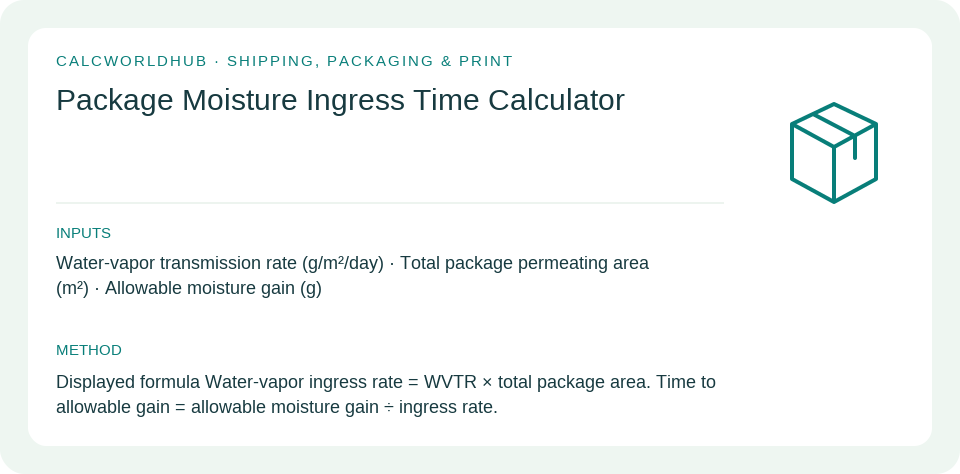
How to use this calculator
Estimate steady water-vapor ingress through a package barrier from WVTR, exposed area, and allowable moisture gain.
- Enter Water-vapor transmission rate (g/m²/day), Total package permeating area (m²), Allowable moisture gain (g). Match the units shown beside each field and review the result together with the assumptions below.
- Read the worked example below to check the expected input format and result.
- Compare another scenario by changing one input at a time. Use Reset to return to the starting values.
How this calculation works
A package water-vapor transmission rate describes moisture passing through a barrier per unit area and time under stated test conditions. Multiplying WVTR by the total exposed area gives an idealized ingress rate, which can be compared with a user-selected allowable moisture gain.
Inputs and units
wvtr— Water-vapor transmission rate (g/m²/day)- WVTR for the barrier under the selected test conditions; use a nonnegative value.
area— Total package permeating area (m²)- Sum the package faces through which the barrier is exposed; exclude overlapping seams if not included in the test value.
gain— Allowable moisture gain (g)- User-defined maximum water-vapor ingress before a chosen product limit is reached.
Formula
Water-vapor ingress rate = WVTR × total package area. Time to allowable gain = allowable moisture gain ÷ ingress rate.
Method
Use a WVTR value in grams per square metre per day and the total permeating package area in square metres. The result is a constant-rate screening estimate.
Worked example
At a WVTR of 0.8 g/m²/day across 0.6 m² of package area, modeled ingress is 0.48 g/day. A 4 g allowable gain is reached in about 8.33 days under the constant-rate assumption.
Assumptions and limits
The entered WVTR must represent conditions close to the intended storage conditions. This estimate assumes steady permeation and does not model seals, closures, pinholes, changing humidity, product sorption, or chemical and sensory stability.
Frequently asked questions
Where does the WVTR value come from?
Use a barrier-material test or supplier specification that states its test conditions.
Does the result predict food shelf life?
No. It estimates only moisture ingress through the entered barrier area under a constant-rate assumption.
Should package seams be included?
Include all area that contributes to permeation, and account for seal leakage separately if it is known.
What if the allowable moisture gain is zero?
With a positive modeled ingress rate, the limit is already met at time zero, so the result is 0 days. A zero ingress rate cannot increase moisture under this steady-rate model.
How do I use the Package Moisture Ingress Time Calculator?
Enter Water-vapor transmission rate (g/m²/day), Total package permeating area (m²), Allowable moisture gain (g). Match the units shown beside each field and review the result together with the assumptions below.
Reference: ASTM F1249-25 water-vapor transmission rate method for flexible barrier materials. See our calculation methodology.