Packaging carbon estimate calculator
Estimate material footprint from your own emission factors. Enter your values below for a free estimate, with no account required.
Calculator
How to use this calculator
Multiply material mass per package by a matching emissions factor and by the number of packages.
- Enter Material per package (kg), Emission factor (kg CO₂e/kg), Packages. Match the units shown beside each field and review the result together with the assumptions below.
- Read the worked example below to check the expected input format and result.
- Compare another scenario by changing one input at a time. Use Reset to return to the starting values.
Estimate emissions from packaging material use
Multiply material mass per package by a matching emissions factor and by the number of packages.
Inputs and units
- Material per package (kg)
- Emission factor (kg CO₂e/kg)
- Packages
Formula and method
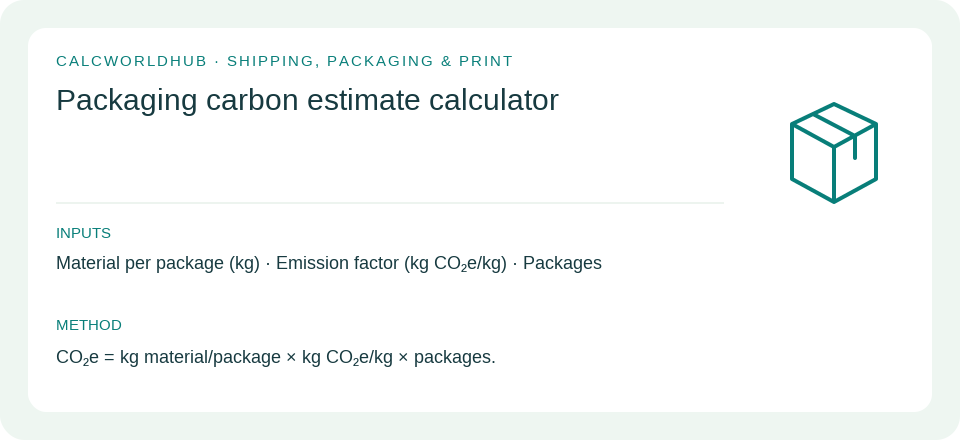
CO₂e = kg material/package × kg CO₂e/kg × packages.
Worked example
0.12 kg/package × 1.5 kg CO₂e/kg × 1,000 packages = 180 kg CO₂e.
Interpreting the result
The estimate scales linearly with package count and the chosen factor.
Assumptions and limits
The entered factor controls material, geography, lifecycle boundary, and reporting method. Do not compare estimates built from mismatched factor boundaries.
Method references
Frequently asked questions
Does this include transport or disposal?
Only when those stages are included in the factor you enter.
How do I use the Packaging carbon estimate calculator?
Enter Material per package (kg), Emission factor (kg CO₂e/kg), Packages. Match the units shown beside each field and review the result together with the assumptions below.
What is a worked example of Packaging carbon estimate?
0.12 kg/package × 1.5 kg CO₂e/kg × 1,000 packages = 180 kg CO₂e.
What does the Packaging carbon estimate calculator calculate?
Multiply material mass per package by a matching emissions factor and by the number of packages.
What assumptions apply to Packaging carbon estimate?
The entered factor controls material, geography, lifecycle boundary, and reporting method. Do not compare estimates built from mismatched factor boundaries.
Good calculators show their work.
CalcWorldHub is built around clear inputs and visible assumptions. Results are estimates for planning; check official sources or your provider’s terms when exact figures matter.