How to use this calculator
Convert a supplied Taylor series into a rational approximant that matches the same series order at its expansion center.
- Enter Taylor coefficients, ascending order, Denominator degree, Evaluation argument. Match the units shown beside each field and review the result together with the assumptions below.
- Read the worked example below to check the expected input format and result.
- Compare another scenario by changing one input at a time. Use Reset to return to the starting values.
Pade rational approximation from a power series explained
A Padé approximant matches a truncated series with a rational function; a denominator close to zero at the evaluation point can make the estimate unstable.
Inputs, symbols, and units
coeff— Taylor coefficients, ascending order- Coefficients c0,c1,...; these already include factorial division. Use comma-separated values in the stated order.
denorder— Denominator degree- Degree m of the normalized denominator, below coefficient count. Enter a whole number.
x— Evaluation argument- Argument measured from the power-series expansion center.
Formula and method
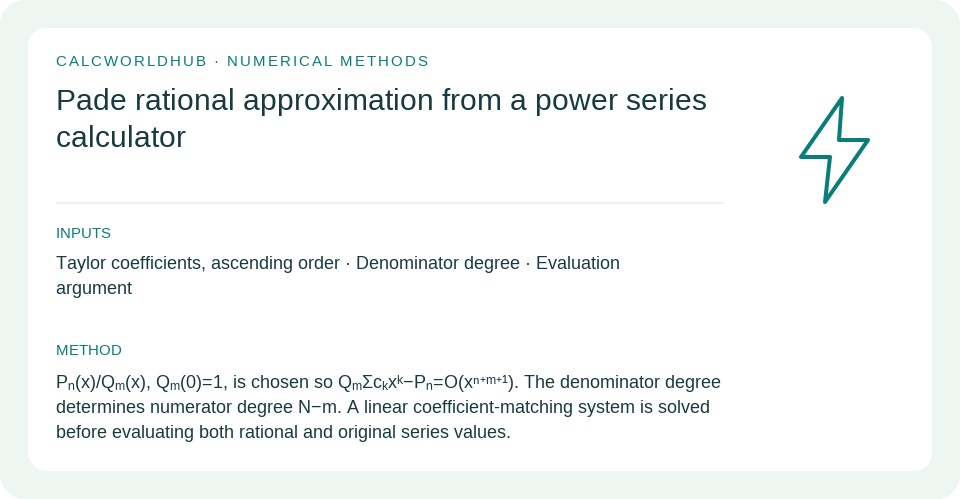
Pₙ(x)/Qₘ(x), Qₘ(0)=1, is chosen so QₘΣcₖxᵏ−Pₙ=O(xⁿ⁺ᵐ⁺¹).
The denominator degree determines numerator degree N−m. A linear coefficient-matching system is solved before evaluating both rational and original series values.
A worked scenario
Taylor coefficients, ascending order = [1, 1, 0.5, 0.16666666666666666, 0.041666666666666664]; Denominator degree = 2; Evaluation argument = 1.
- Pade approximation: 2.714286 function units
- Normalized denominator: 0.583333
- Original truncated series: 2.708333 function units
The five standard exponential coefficients form the [2/2] approximant, which gives 2.7142857 at x=1 versus the series value 2.7083333.
Assumptions and edge cases
Singular coefficient-matching systems and evaluation poles are rejected. A rational approximation can invent poles absent from the true function.
Reading the outputs
Rational value and original Taylor value use function units. The denominator identifies proximity to an approximant pole.
Frequently asked questions
Are the inputs derivatives or series coefficients?
Series coefficients, with factorials already divided out.
Why can a pole appear?
A rational approximant has denominator zeros, which may be spurious.
Is it always better than the Taylor polynomial?
No. Accuracy depends on the function, degree choice and argument.
How do I use the Pade rational approximation from a power series calculator?
Enter Taylor coefficients, ascending order, Denominator degree, Evaluation argument. Match the units shown beside each field and review the result together with the assumptions below.
What is a worked example of Pade rational approximation from a power series?
Taylor coefficients, ascending order = [1, 1, 0.5, 0.16666666666666666, 0.041666666666666664]; Denominator degree = 2; Evaluation argument = 1. Pade approximation: 2.714286 function units Normalized denominator: 0.583333 Original truncated series: 2.708333 function units The five standard exponential coefficients form the [2/2] approximant, which gives 2.7142857 at x=1 versus the series value 2.7083333.
Background or definition reference: NIST DLMF approximation techniques.
Read our calculation methodology.