How to use this calculator
Find road-profile elevation and grade at a station along a symmetric parabolic vertical curve.
- Enter PVC elevation, Initial grade g1 (%), Final grade g2 (%), Vertical curve length L, then complete the remaining labeled fields. Match the units shown beside each field and review the result together with the assumptions below.
- Read the worked example below to check the expected input format and result.
- Compare another scenario by changing one input at a time. Use Reset to return to the starting values.
How this calculation works
A parabolic vertical curve changes grade uniformly with horizontal distance. Starting from the PVC elevation and initial grade, the elevation at a point is found by adding the tangent-grade rise and the parabolic correction based on the algebraic grade change and curve length.
Inputs and units
pvc— PVC elevation- Known elevation at the beginning of the curve, in your chosen length unit.
g1— Initial grade g1 (%)- Approach tangent grade in percent; uphill is positive.
g2— Final grade g2 (%)- Departure tangent grade in percent; downhill is negative.
length— Vertical curve length L- Horizontal curve length in the same distance unit used for x.
x— Distance from PVC x- Station offset from PVC, between zero and the full curve length.
Formula
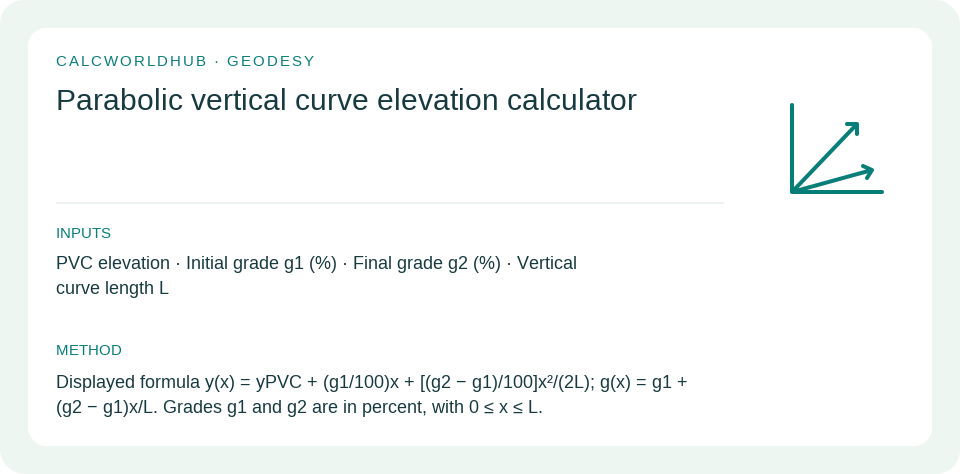
y(x) = yPVC + (g1/100)x + [(g2 − g1)/100]x²/(2L); g(x) = g1 + (g2 − g1)x/L. Grades g1 and g2 are in percent, with 0 ≤ x ≤ L.
Method
Enter elevation at the beginning of vertical curve (PVC), initial and final grades in percent, full curve length, and distance from PVC to the station. The result reports profile elevation and instantaneous grade at that point.
Worked example
With PVC elevation 100, g1 = +2%, g2 = −1%, L = 120, and x = 45, elevation is 100 + 0.02×45 − 0.03×45²/(2×120) = 100.646875; grade there is +0.875%.
Assumptions and limits
This computes geometry for a symmetric parabolic curve only. It does not select a design speed, sight-distance criterion, drainage condition, minimum curve length, station equation, or jurisdictional design standard. Confirm units and project criteria before use in design.
Frequently asked questions
What is the PVC?
It is the point where the parabolic vertical curve begins and joins the initial tangent grade.
Can the curve be a sag or a crest?
Yes. Enter the signed initial and final grades; their difference determines whether the grade rises or falls through the curve.
Does the station need to be within the curve?
Yes. The offset x must be between zero and the full curve length L.
Does this determine a safe highway curve length?
No. Design criteria such as speed, sight distance, drainage, and governing standards must be evaluated separately.
How do I use the Parabolic vertical curve elevation calculator?
Enter PVC elevation, Initial grade g1 (%), Final grade g2 (%), Vertical curve length L, then complete the remaining labeled fields. Match the units shown beside each field and review the result together with the assumptions below.
Reference: TxDOT Roadway Design Manual vertical-curve guidance. See our calculation methodology.