How to use this calculator
Track daughter ingrowth and decay from an initially daughter-free parent sample.
- Enter Initial parent atoms, Parent half-life (hours), Daughter half-life (hours), Elapsed time (hours). Match the units shown beside each field and review the result together with the assumptions below.
- Read the worked example below to check the expected input format and result.
- Compare another scenario by changing one input at a time. Use Reset to return to the starting values.
Parent daughter radioactive decay chain explained
A daughter nuclide is produced by parent decay while also undergoing its own decay. The two-member Bateman model balances those processes from an initially pure parent sample and reports daughter abundance separately from surviving parent atoms.
Inputs, symbols, and units
n— Initial parent atoms- Number of parent atoms at time zero; the initial daughter count is assumed to be zero.
a— Parent half-life (hours)- Positive parent half-life, in hours. Its decay constant is ln(2) divided by this value.
b— Daughter half-life (hours)- Positive daughter half-life in the same hour unit; a stable daughter is outside this finite-half-life input model.
t— Elapsed time (hours)- Nonnegative time since the initially pure parent sample was defined, in hours.
Formula and method
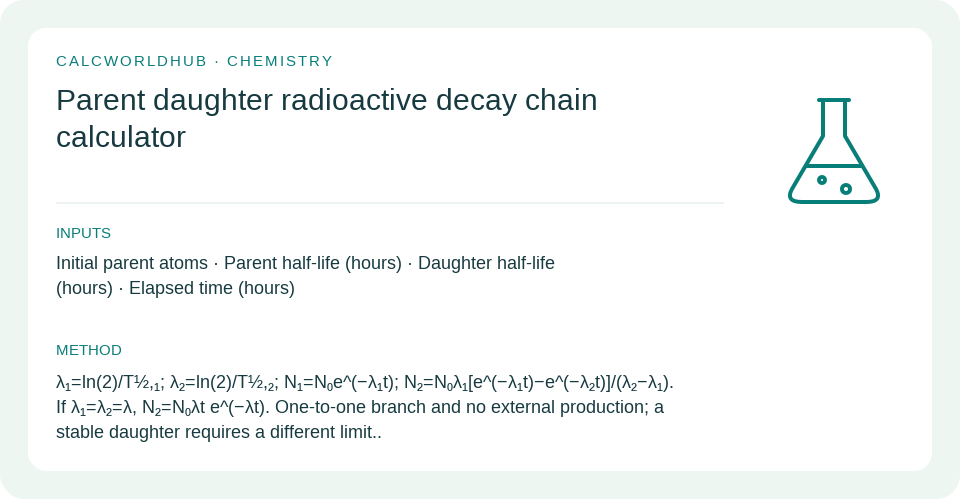
λ₁=ln(2)/T½,₁; λ₂=ln(2)/T½,₂; N₁=N₀e^(−λ₁t); N₂=N₀λ₁[e^(−λ₁t)−e^(−λ₂t)]/(λ₂−λ₁). If λ₁=λ₂=λ, N₂=N₀λt e^(−λt).
One-to-one branch and no external production; a stable daughter requires a different limit..
A worked scenario
Initial parent atoms = 1000000; Parent half-life (hours) = 10; Daughter half-life (hours) = 5; Elapsed time (hours) = 10.
- Daughter atoms: 250000 atoms
- Remaining parent atoms: 500000 atoms
Here λ₁=ln(2)/10 and λ₂=ln(2)/5 per hour. After 10 hours the parent is halved to 500,000 atoms; the two-member balance gives 250,000 daughter atoms. Daughter production is not the same as the cumulative number of parent decays because daughters also decay.
Assumptions and edge cases
One-to-one branch and no external production; a stable daughter requires a different limit.
Frequently asked questions
What if half-lives are equal?
The solver uses the equal-rate limit.
Is initial daughter allowed?
This version assumes none.
Can I use branching decay?
Only a complete one-to-one branch is represented.
How do I use the Parent daughter radioactive decay chain calculator?
Enter Initial parent atoms, Parent half-life (hours), Daughter half-life (hours), Elapsed time (hours). Match the units shown beside each field and review the result together with the assumptions below.
What is a worked example of Parent daughter radioactive decay chain?
Initial parent atoms = 1000000; Parent half-life (hours) = 10; Daughter half-life (hours) = 5; Elapsed time (hours) = 10. Daughter atoms: 250000 atoms Remaining parent atoms: 500000 atoms Here λ₁=ln(2)/10 and λ₂=ln(2)/5 per hour. After 10 hours the parent is halved to 500,000 atoms; the two-member balance gives 250,000 daughter atoms. Daughter production is not the same as the cumulative number of parent decays because daughters also decay.
Reference: IAEA radiotracer-generator handbook: parent-daughter Bateman equations.
Read our calculation methodology.