How to use this calculator
Inspect element growth during Gaussian elimination with partial row pivoting, a diagnostic relevant to rounding-error amplification.
- Enter Square coefficient matrix. Match the units shown beside each field and review the result together with the assumptions below.
- Read the worked example below to check the expected input format and result.
- Compare another scenario by changing one input at a time. Use Reset to return to the starting values.
Partial pivoting elimination growth factor explained
Partial pivoting selects the largest available entry in each column as the pivot; the growth factor tracks how large intermediate elimination entries become relative to the original matrix.
Inputs, symbols, and units
a— Square coefficient matrix- Row-major square matrix; growth follows each Schur complement. Use comma-separated values in the stated order.
Formula and method
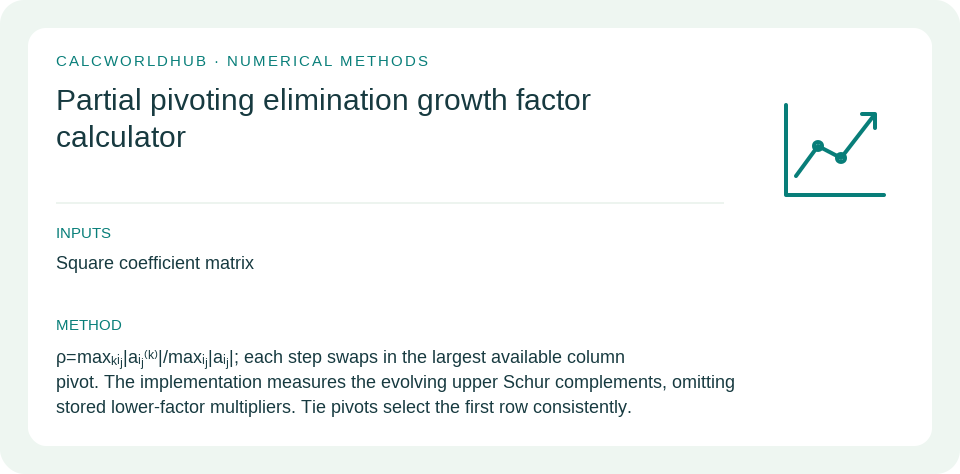
ρ=maxₖᵢⱼ|aᵢⱼ⁽ᵏ⁾|/maxᵢⱼ|aᵢⱼ|; each step swaps in the largest available column pivot.
The implementation measures the evolving upper Schur complements, omitting stored lower-factor multipliers. Tie pivots select the first row consistently.
A worked scenario
Square coefficient matrix = [1, 0, 0, 1, -1, 1, 0, 1, -1, -1, 1, 1, -1, -1, -1, 1].
- Element growth factor: 8
- Smallest absolute pivot: 1
- Determinant: 8
The default four-by-four Wilkinson-style matrix produces growth factor eight despite entries of magnitude one.
Assumptions and edge cases
This is a diagnostic, not a condition number or an error bound. Near-zero absolute pivots are rejected; rescale extremely small matrices before entry.
Reading the outputs
Growth factor is dimensionless. Smallest pivot retains matrix units; determinant has the corresponding determinant units.
Frequently asked questions
Does a small growth factor imply a well-conditioned matrix?
No. Conditioning concerns sensitivity of the equation, whereas growth concerns this elimination path.
Why can row swaps change growth?
Different pivots change every later Schur complement.
Is the lower factor included?
No. The diagnostic tracks active Schur-complement entries and the upper factor.
How do I use the Partial pivoting elimination growth factor calculator?
Enter Square coefficient matrix. Match the units shown beside each field and review the result together with the assumptions below.
What is a worked example of Partial pivoting elimination growth factor?
Square coefficient matrix = [1, 0, 0, 1, -1, 1, 0, 1, -1, -1, 1, 1, -1, -1, -1, 1]. Element growth factor: 8 Smallest absolute pivot: 1 Determinant: 8 The default four-by-four Wilkinson-style matrix produces growth factor eight despite entries of magnitude one.
Background or definition reference: NIST DLMF numerical methods.
Read our calculation methodology.