How to use this calculator
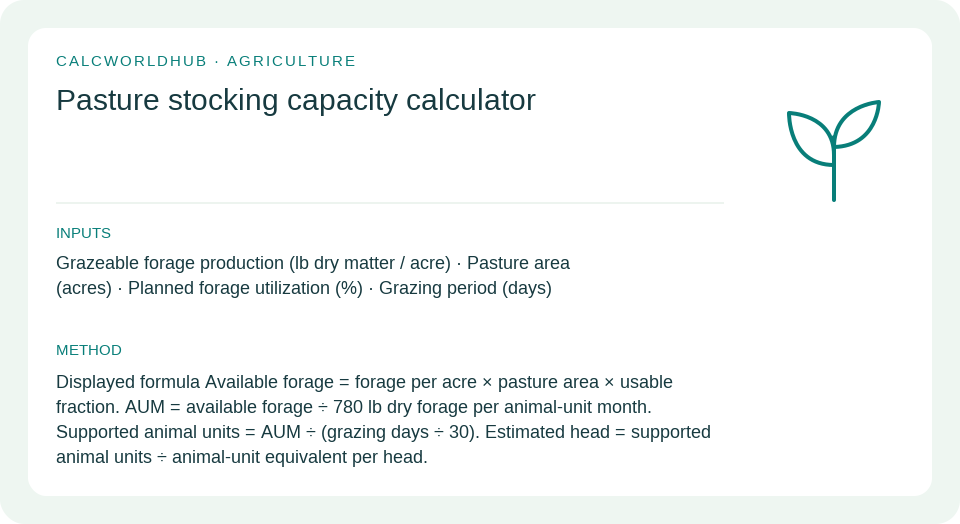
Estimate animal-unit capacity from grazeable forage, pasture area, utilization, and grazing duration.
- Enter Grazeable forage production (lb dry matter / acre), Pasture area (acres), Planned forage utilization (%), Grazing period (days), then complete the remaining labeled fields. Match the units shown beside each field and review the result together with the assumptions below.
- Read the worked example below to check the expected input format and result.
- Compare another scenario by changing one input at a time. Use Reset to return to the starting values.
How this calculation works
A pasture forage budget connects measured dry forage with the time livestock will graze a defined area. Enter forage per acre, total acres, the share considered usable, and the grazing period. The animal-unit equivalent converts supported animal units into an approximate head count for the livestock type.
Inputs and units
yield— Grazeable forage production (lb dry matter / acre)- Forage dry matter available before applying the utilization fraction.
area— Pasture area (acres)- Area contributing forage to this grazing budget.
utilization— Planned forage utilization (%)- Share of measured forage available for the planned grazing period.
days— Grazing period (days)- Length of the grazing period.
auPerHead— Animal-unit equivalent per head- Enter a locally appropriate equivalent for the animal class; 1 represents one animal unit.
Formula
Available forage = forage per acre × pasture area × usable fraction. AUM = available forage ÷ 780 lb dry forage per animal-unit month. Supported animal units = AUM ÷ (grazing days ÷ 30). Estimated head = supported animal units ÷ animal-unit equivalent per head.
Method
The estimate uses 780 lb of dry forage per animal-unit month and a 30-day month. Utilization is the fraction of standing forage planned for consumption; the animal-unit equivalent should reflect the animal class and management convention used.
Worked example
For 2,000 lb dry matter per acre across 20 acres at 40% utilization, available forage is 16,000 lb. That equals 20.51 AUM; for 120 days, the estimate is 20.51 ÷ 4 = 5.13 animal units.
Assumptions and limits
The 780 lb convention and usable forage fraction are planning assumptions, not a universal prescription. Forage regrowth, forage quality, season, soil, animal size and lactation, water access, and grazing distribution can materially change a safe stocking plan. Verify local extension guidance before stocking.
Frequently asked questions
What is an animal-unit month?
It expresses forage demand for one animal unit for one month. This estimate uses a 780 lb dry-forage convention; local guidance may use different assumptions.
Does the calculator account for forage regrowth?
No. It treats the entered grazeable forage as a fixed budget for the entered period.
How do I convert animal units to head?
Divide supported animal units by the animal-unit equivalent per head for your livestock class and production situation.
How do I use the Pasture stocking capacity calculator?
Enter Grazeable forage production (lb dry matter / acre), Pasture area (acres), Planned forage utilization (%), Grazing period (days), then complete the remaining labeled fields. Match the units shown beside each field and review the result together with the assumptions below.
What is a worked example of Pasture stocking capacity?
For 2,000 lb dry matter per acre across 20 acres at 40% utilization, available forage is 16,000 lb. That equals 20.51 AUM; for 120 days, the estimate is 20.51 ÷ 4 = 5.13 animal units.
Reference: Oklahoma State Extension stocking-rate guidance. See our calculation methodology.