How to use this calculator
Compare the signed change between two percentage rates, their absolute gap in percentage points, and their relative percent change.
- Enter the starting and new rates as percentages on the same basis. Read signed Difference for direction, Absolute gap for magnitude, and Relative change for the change divided by the starting rate.
- Use the worked example to check the input basis and units.
- Change one input at a time to compare scenarios; Reset restores the starting values.
How this calculation works
The signed percentage-point change is the new rate minus the starting rate. Its sign shows the direction of change. The separately displayed Absolute gap is the magnitude of that change. Relative percent change divides that same difference by the starting rate, so the two measures answer different questions.
Inputs and meanings
oldRate— Starting rate (%)- Enter the original percentage rate, from 0 to 100.
newRate— New rate (%)- Enter the later percentage rate using the same basis.
Formula and method
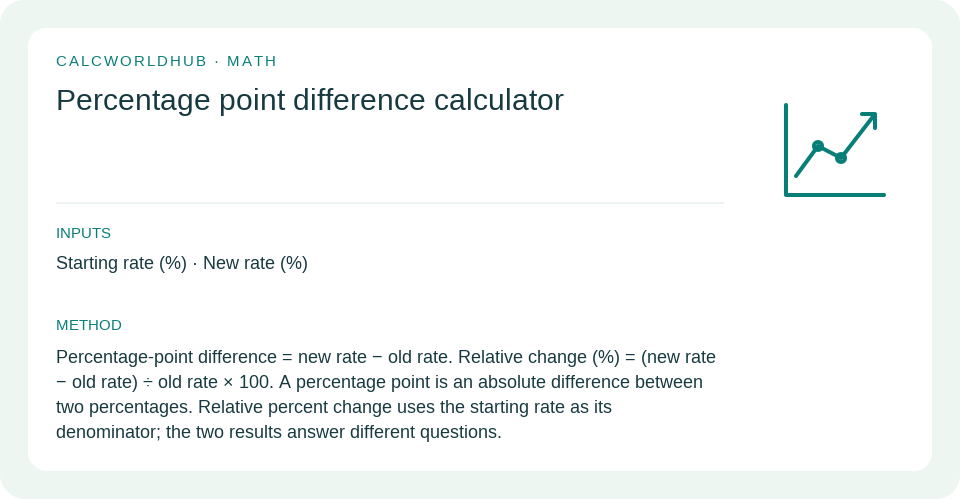
Percentage-point difference = new rate − old rate. Relative change (%) = (new rate − old rate) ÷ old rate × 100.
A percentage point is an absolute difference between two percentages. Relative percent change uses the starting rate as its denominator; the two results answer different questions.
Worked example
A move from 20% to 15% gives a signed change of −5 percentage points, an absolute gap of 5 points and a relative change of −25%. A move from 12.5% to 16% gives +3.5 points and +28% relative change.
For rates of 12.5% and 16%, the absolute difference is 16 − 12.5 = 3.5 percentage points; relative change is 3.5 ÷ 12.5 × 100 = 28%.
Assumptions and limits
Rates must use the same definition and population. Relative change is undefined when the old rate is zero.
Frequently asked questions
Why are Difference and Absolute gap different for a decrease?
Difference keeps the sign of new minus old. Absolute gap reports its magnitude without a negative sign.
Is a five-point drop always a five-percent drop?
No. Relative percent change divides by the starting rate. From 20% to 15%, the drop is five percentage points and 25% of the starting rate.
What happens when the starting rate is zero?
The point difference is still defined, but relative percent change is undefined because it divides by the starting rate.
Can I compare rates from different populations?
The arithmetic can subtract them, but interpretation requires comparable definitions, populations and measurement periods.
Read our calculation methodology.