How to use this calculator
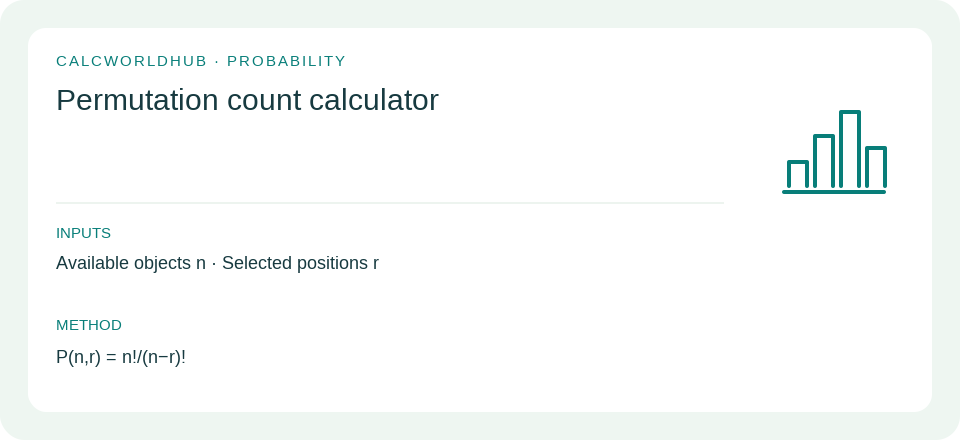
Count ordered selections of r distinct objects from n, without replacement. Different orders count as different arrangements.
- Enter Available objects n, Selected positions r. Match the units shown beside each field and review the result together with the assumptions below.
- Read the worked example below to check the expected input format and result.
- Compare another scenario by changing one input at a time. Use Reset to return to the starting values.
How Permutation count calculator works
Count ordered selections of r distinct objects from n, without replacement. Different orders count as different arrangements.
Inputs and units
- Available objects n: Total available objects n, a whole number in the supported range.
- Selected positions r: Number of ordered positions r, a whole number from 0 through n.
Formula and method
P(n,r) = n!/(n−r)!
Worked example
For n=5 and r=2 there are 5×4=20 ordered arrangements.
Interpreting the result
P(n,0)=1; when r=n, the count is n!.
Assumptions and limits
Objects are distinct and are not reused. The result is a count, not the probability of a particular arrangement.
Sources and method
- The nCr and nPr formulas distinguish unordered selections from ordered arrangements. OpenStax counting equations
Frequently asked questions
How does this differ from combinations?
Permutations distinguish order; combinations count the same selected group once.
Why does choosing zero positions return one?
There is one empty arrangement, the standard counting identity.
How do I use the Permutation count calculator?
Enter Available objects n, Selected positions r. Match the units shown beside each field and review the result together with the assumptions below.
What is a worked example of Permutation count?
For n=5 and r=2 there are 5×4=20 ordered arrangements.
What does the Permutation count calculator calculate?
Count ordered selections of r distinct objects from n, without replacement. Different orders count as different arrangements.