How to use this calculator
Normalize a sample against a calibrator while allowing target and reference assays to have different amplification factors.
- Enter Target amplification factor per cycle, Reference amplification factor per cycle, Target Cq in calibrator, Target Cq in sample, then complete the remaining labeled fields. Match the units shown beside each field and review the result together with the assumptions below.
- Read the worked example below to check the expected input format and result.
- Compare another scenario by changing one input at a time. Use Reset to return to the starting values.
Pfaffl efficiency corrected expression ratio explained
The Pfaffl ratio corrects target-gene fold change by the reference-gene fold change. Each assay uses its own amplification factor and its calibrator-minus-sample Cq difference, so reference normalization can raise or lower the target ratio.
Inputs, symbols, and units
et— Target amplification factor per cycle- Target amplification factor per cycle.
er— Reference amplification factor per cycle- Reference amplification factor per cycle.
tc— Target Cq in calibrator- Target Cq in calibrator.
ts— Target Cq in sample- Target Cq in sample.
rc— Reference Cq in calibrator- Reference Cq in calibrator.
rs— Reference Cq in sample- Reference Cq in sample.
Formula and method
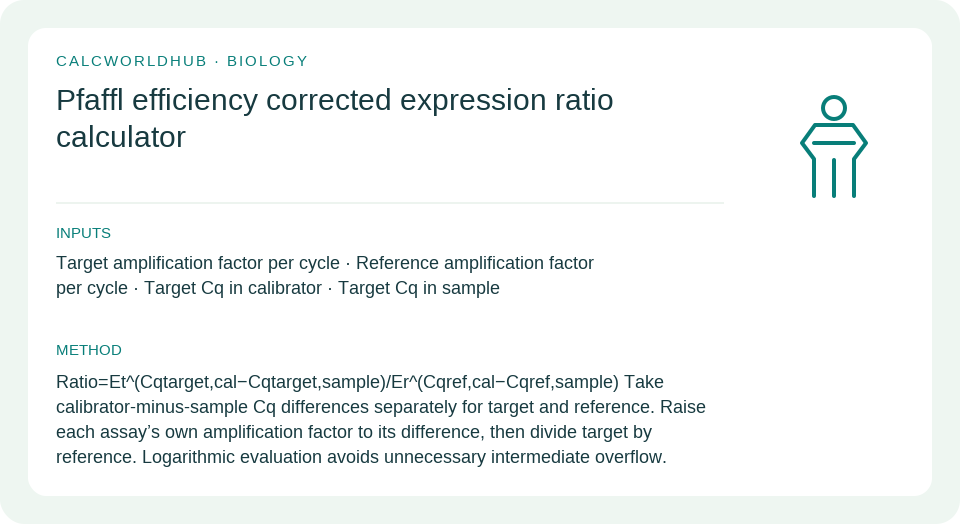
Ratio=Et^(Cqtarget,cal−Cqtarget,sample)/Er^(Cqref,cal−Cqref,sample)
Take calibrator-minus-sample Cq differences separately for target and reference. Raise each assay’s own amplification factor to its difference, then divide target by reference. Logarithmic evaluation avoids unnecessary intermediate overflow.
A worked scenario
Target amplification factor per cycle = 1.95; Reference amplification factor per cycle = 1.9; Target Cq in calibrator = 25; Target Cq in sample = 23; Reference Cq in calibrator = 20; Reference Cq in sample = 19.
- Efficiency-corrected relative expression: 2.00131579 fold
Target difference is 25−23=2 cycles and reference difference is 20−19=1. The normalized ratio is 1.95²/1.9=2.001315789 fold.
Assumptions and edge cases
Stable reference behavior, valid assay efficiencies, and comparable samples are assumed. This is an arithmetic relative-expression model, not a diagnostic interpretation.
Frequently asked questions
Are efficiency inputs percentages?
No, enter 1.95 for a 95% amplification efficiency.
How does it relate to 2^−ΔΔCq?
It reduces to that form when both factors equal two under consistent Cq differences.
Does it validate the reference gene?
No.
How do I use the Pfaffl efficiency corrected expression ratio calculator?
Enter Target amplification factor per cycle, Reference amplification factor per cycle, Target Cq in calibrator, Target Cq in sample, then complete the remaining labeled fields. Match the units shown beside each field and review the result together with the assumptions below.
What is a worked example of Pfaffl efficiency corrected expression ratio?
Target amplification factor per cycle = 1.95; Reference amplification factor per cycle = 1.9; Target Cq in calibrator = 25; Target Cq in sample = 23; Reference Cq in calibrator = 20; Reference Cq in sample = 19. Efficiency-corrected relative expression: 2.00131579 fold Target difference is 25−23=2 cycles and reference difference is 20−19=1. The normalized ratio is 1.95²/1.9=2.001315789 fold.
Method reference: Pfaffl 2001 relative quantification model.
Read our calculation methodology.