How to use this calculator
Size charging time through solid warming, melting and liquid warming while accounting for continuous heat leakage.
- Enter Phase-change material mass (kg), Solid heat capacity (J/kg/K), Liquid heat capacity (J/kg/K), Latent melting heat (J/kg), then complete the remaining labeled fields. Match the units shown beside each field and review the result together with the assumptions below.
- Read the worked example below to check the expected input format and result.
- Compare another scenario by changing one input at a time. Use Reset to return to the starting values.
Phase change thermal store charging time with heat leakage explained
Charging time is integrated over three phases: warming the solid, melting at the transition temperature, then warming the liquid. The model assumes constant heater power and linear heat leak to a fixed ambient; if net power cannot reach a phase temperature, no finite charge time exists.
Inputs, symbols, and units
m— Phase-change material mass (kg)- Phase-change material mass (kg). Enter the value for this state; the units shown are used without an unstated conversion.
cs— Solid heat capacity (J/kg/K)- Solid heat capacity (J/kg/K). Enter the value for this state; the units shown are used without an unstated conversion.
cl— Liquid heat capacity (J/kg/K)- Liquid heat capacity (J/kg/K). Enter the value for this state; the units shown are used without an unstated conversion.
latent— Latent melting heat (J/kg)- Latent melting heat (J/kg). Enter the value for this state; the units shown are used without an unstated conversion.
Ti— Starting solid temperature (°C)- Starting solid temperature (°C). Enter the value for this state; the units shown are used without an unstated conversion.
Tm— Sharp melting temperature (°C)- Sharp melting temperature (°C). Enter the value for this state; the units shown are used without an unstated conversion.
Tf— Required final liquid temperature (°C)- Required final liquid temperature (°C). Enter the value for this state; the units shown are used without an unstated conversion.
P— Constant heater power (W)- Constant heater power (W). Enter the value for this state; the units shown are used without an unstated conversion.
G— Store to ambient loss conductance (W/K)- Store to ambient loss conductance (W/K). Enter the value for this state; the units shown are used without an unstated conversion.
Ta— Fixed ambient temperature (°C)- Fixed ambient temperature (°C). Enter the value for this state; the units shown are used without an unstated conversion.
Formula and method
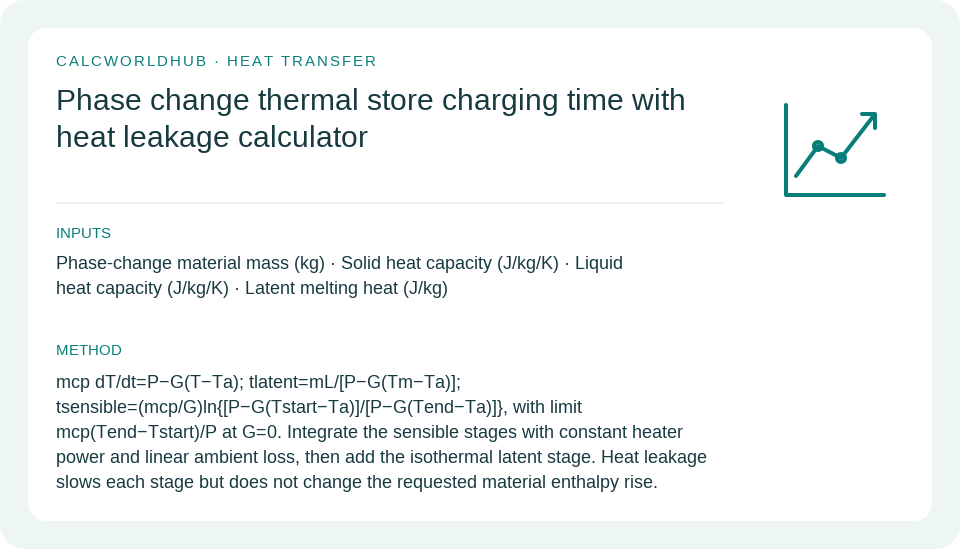
mcp dT/dt=P−G(T−Ta); tlatent=mL/[P−G(Tm−Ta)]; tsensible=(mcp/G)ln{[P−G(Tstart−Ta)]/[P−G(Tend−Ta)]}, with limit mcp(Tend−Tstart)/P at G=0.
Integrate the sensible stages with constant heater power and linear ambient loss, then add the isothermal latent stage. Heat leakage slows each stage but does not change the requested material enthalpy rise.
A worked scenario
Phase-change material mass (kg) = 10; Solid heat capacity (J/kg/K) = 2000; Liquid heat capacity (J/kg/K) = 2200; Latent melting heat (J/kg) = 200000; Starting solid temperature (°C) = 20; Sharp melting temperature (°C) = 50; Required final liquid temperature (°C) = 60; Constant heater power (W) = 1000; Store to ambient loss conductance (W/K) = 5; Fixed ambient temperature (°C) = 20.
- Total charging time: 3269.76523 s
- Time spent melting at fixed temperature: 2352.941176 s
- Material enthalpy gained: 2820000 J
A 10 kg store warms from 20 to a 50 °C melting point, absorbs 200 kJ/kg latent heat, then reaches 60 °C. With a 1,000 W heater and 5 W/K ambient leakage it takes 3,269.77 s; 2,352.94 s is spent melting while total material enthalpy rises 2.82 MJ.
Assumptions and edge cases
Uniform material temperature, a single sharp melting point, complete melting, constant phase heat capacities and no subcooling, volume change or internal thermal resistance.
Reading the outputs
Total and melting times are s; stored material enthalpy gain is J, which excludes energy lost to ambient.
Frequently asked questions
Why can charging time become infinite?
If heater power equals loss at a target state, the store approaches that state asymptotically and cannot finish beyond it.
Is electrical energy equal to stored heat?
No when the loss conductance is nonzero; electrical input is power times total time.
Can I model partial melting?
This page always completes the entered latent heat. A melt-fraction state balance is needed for partial charge.
How do I use the Phase change thermal store charging time with heat leakage calculator?
Enter Phase-change material mass (kg), Solid heat capacity (J/kg/K), Liquid heat capacity (J/kg/K), Latent melting heat (J/kg), then complete the remaining labeled fields. Match the units shown beside each field and review the result together with the assumptions below.
What is a worked example of Phase change thermal store charging time with heat leakage?
Phase-change material mass (kg) = 10; Solid heat capacity (J/kg/K) = 2000; Liquid heat capacity (J/kg/K) = 2200; Latent melting heat (J/kg) = 200000; Starting solid temperature (°C) = 20; Sharp melting temperature (°C) = 50; Required final liquid temperature (°C) = 60; Constant heater power (W) = 1000; Store to ambient loss conductance (W/K) = 5; Fixed ambient temperature (°C) = 20. Total charging time: 3269.76523 s Time spent melting at fixed temperature: 2352.941176 s Material enthalpy gained: 2820000 J A 10 kg store warms from 20 to a 50 °C melting point, absorbs 200 kJ/kg latent heat, then reaches 60 °C.
Read our calculation methodology.