How to use this calculator
Convert a combined fitting loss coefficient into an equivalent straight-pipe length.
- Enter Combined fitting loss coefficient K_sum, Actual inside pipe diameter D (m), Darcy friction factor f_D. Match the units shown beside each field and review the result together with the assumptions below.
- Read the worked example below to check the expected input format and result.
- Compare another scenario by changing one input at a time. Use Reset to return to the starting values.
How this calculation works
Designers sometimes compare valves, bends, entrances, or other fittings with the friction loss in an equivalent length of straight pipe. This tool turns a summed local-loss coefficient into that length for one selected Darcy friction factor and inside diameter.
Inputs and units
minorK— Combined fitting loss coefficient K_sum- Add the dimensionless K values for the fittings being represented.
diameter— Actual inside pipe diameter D (m)- Use internal diameter rather than nominal pipe size.
darcyFactor— Darcy friction factor f_D- Use the Darcy factor for the pipe and flow condition; it is four times the Fanning factor.
Formula
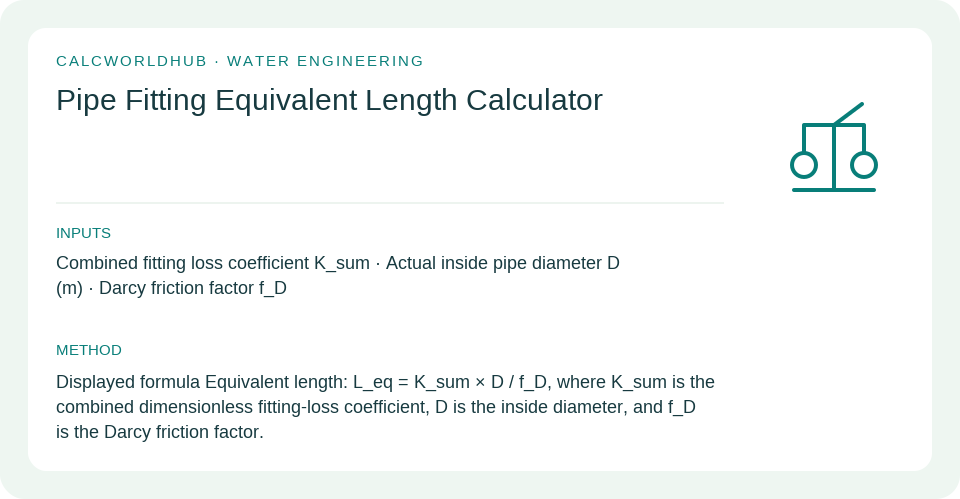
Equivalent length: L_eq = K_sum × D / f_D, where K_sum is the combined dimensionless fitting-loss coefficient, D is the inside diameter, and f_D is the Darcy friction factor.
Method
The equivalence follows by setting the fitting loss K_sum·V²/(2g) equal to straight-pipe Darcy–Weisbach loss f_D·(L_eq/D)·V²/(2g). The velocity-head terms cancel, so flow rate and fluid density are not needed.
Worked example
For K_sum = 4, an inside diameter of 0.10 m, and a Darcy factor of 0.020, L_eq = 4 × 0.10/0.020 = 20 m, or 200 pipe diameters.
Assumptions and limits
This is a bookkeeping equivalence for the entered fitting coefficients and friction factor. It assumes the coefficients refer to the same mean pipe velocity and do not depend materially on Reynolds number or interaction between closely spaced fittings. It does not estimate the coefficients themselves.
Frequently asked questions
What does equivalent length mean?
It is a straight-pipe length that would produce the same idealized friction loss as the selected fitting group at the same velocity and friction factor.
Do I add this to the measured pipe length?
For a simple system estimate, add the fitting equivalent lengths to the straight length before applying the Darcy–Weisbach equation.
Why is flow rate not an input?
Both losses contain the same velocity-head term, which cancels when the two expressions are equated.
How do I use the Pipe Fitting Equivalent Length Calculator?
Enter Combined fitting loss coefficient K_sum, Actual inside pipe diameter D (m), Darcy friction factor f_D. Match the units shown beside each field and review the result together with the assumptions below.
What is a worked example of Pipe Fitting Equivalent Length?
For K_sum = 4, an inside diameter of 0.10 m, and a Darcy factor of 0.020, L_eq = 4 × 0.10/0.020 = 20 m, or 200 pipe diameters.
Reference: U.S. Geological Survey Darcy–Weisbach pipe-loss reference used for the equivalent-length derivation. See our calculation methodology.