How to use this calculator
Separate a two-dimensional orientation-preserving deformation into rigid rotation and symmetric right stretch.
- Enter Two by two deformation gradient. Match the units shown beside each field and review the result together with the assumptions below.
- Read the worked example below to check the expected input format and result.
- Compare another scenario by changing one input at a time. Use Reset to return to the starting values.
Planar deformation polar decomposition explained
The right polar decomposition expresses a planar deformation as a symmetric stretch followed by a rigid rotation.
A numerical walkthrough
Two by two deformation gradient = [1.2, 0.3, 0.1, 0.9].
- Rigid rotation angle: -5.440332 degrees
- Right-stretch trace: 2.109502
- Reconstruction residual: 1.24126708e-16
- Right stretch U11: 1.185114
- Right stretch U12: 0.21332
- Right stretch U22: 0.924389
The entered gradient (1.2,0.3;0.1,0.9) rotates about −5.44 degrees after its right stretch.
The model behind the numbers
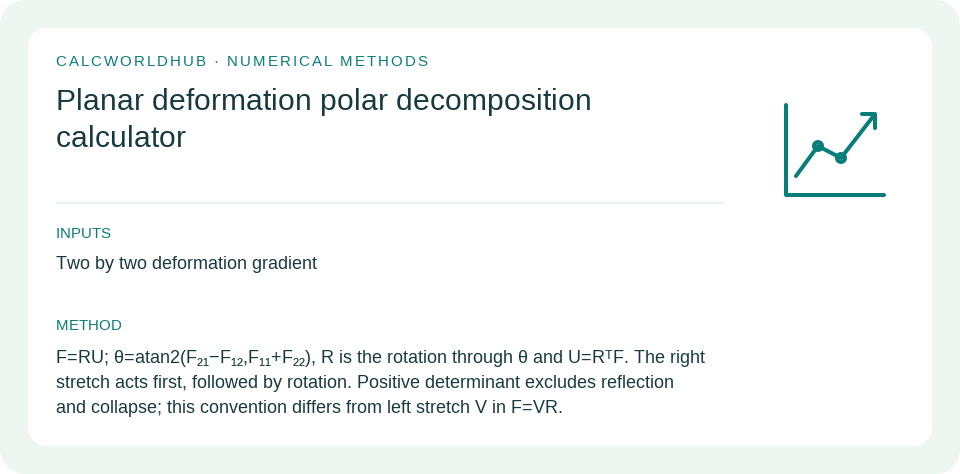
F=RU; θ=atan2(F₂₁−F₁₂,F₁₁+F₂₂), R is the rotation through θ and U=RᵀF.
The right stretch acts first, followed by rotation. Positive determinant excludes reflection and collapse; this convention differs from left stretch V in F=VR.
What to enter
a— Two by two deformation gradient- Four dimensionless row-major components with positive determinant. Use comma-separated values in the stated order.
Interpreting the result
Only real nonsingular 2×2 gradients with positive determinant are supported. The rotation is not an Eulerian strain tensor.
Reading the outputs
Angle is signed counterclockwise in degrees. Stretch trace is dimensionless; reconstruction residual checks F−RU. U11, U12 and U22 fully specify the symmetric right-stretch matrix; combine it with the rotation angle for A=R U.
Frequently asked questions
Why require positive determinant?
A negative determinant contains a reflection and is outside this proper-rotation convention.
Is the symmetric factor a strain tensor?
It is a stretch tensor; a selected strain measure must be formed from it separately.
Does a pure rotation produce stretch?
Its right stretch is the identity, with trace two.
How do I use the Planar deformation polar decomposition calculator?
Enter Two by two deformation gradient. Match the units shown beside each field and review the result together with the assumptions below.
What is a worked example of Planar deformation polar decomposition?
Two by two deformation gradient = [1.2, 0.3, 0.1, 0.9]. Rigid rotation angle: -5.440332 degrees Right-stretch trace: 2.109502 Reconstruction residual: 1.24126708e-16 Right stretch U11: 1.185114 Right stretch U12: 0.21332 Right stretch U22: 0.924389 The entered gradient (1.2,0.3;0.1,0.9) rotates about −5.44 degrees after its right stretch.
Background or definition reference: NIST DLMF numerical methods.
Read our calculation methodology.