How to use this calculator
Write the equation of a nonvertical line from one point and its slope.
- Enter Slope m, Point x-coordinate, Point y-coordinate. Match the units shown beside each field and review the result together with the assumptions below.
- Read the worked example below to check the expected input format and result.
- Compare another scenario by changing one input at a time. Use Reset to return to the starting values.
How this calculation works
A line through the entered point with slope m is written directly in point-slope form, then rearranged to slope-intercept form for substitution or graphing. Both equations describe the same line; the slope-intercept form is unavailable for a vertical line.
Inputs and meanings
slope— Slope m- Enter rise divided by run for the line.
x1— Point x-coordinate- Enter the x-coordinate of a point on the line.
y1— Point y-coordinate- Enter the y-coordinate of the same point.
Formula and method
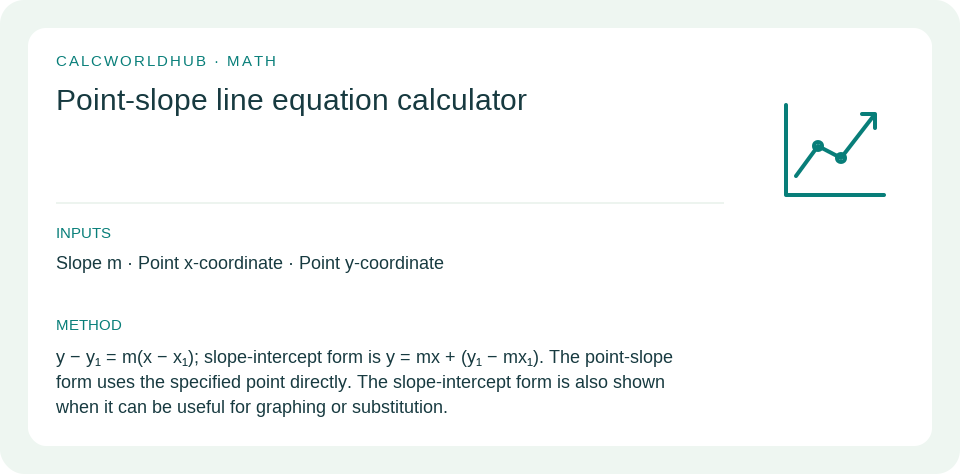
y − y₁ = m(x − x₁); slope-intercept form is y = mx + (y₁ − mx₁).
The point-slope form uses the specified point directly. The slope-intercept form is also shown when it can be useful for graphing or substitution.
Worked example
With slope 2 through (3,5), point-slope form is y−5=2(x−3), which expands to y=2x−1.
Assumptions and limits
The slope must be finite. A vertical line has undefined slope and needs the separate equation x = x₁.
Frequently asked questions
What is point-slope form?
It is y − y₁ = m(x − x₁), where m is slope and (x₁,y₁) lies on the line.
Can this describe a vertical line?
No. Vertical lines have undefined slope and are written x = a constant.
Why show slope-intercept form too?
It makes the y-intercept visible and can simplify graphing or substitution.
How do I use the Point-slope line equation calculator?
Enter Slope m, Point x-coordinate, Point y-coordinate. Match the units shown beside each field and review the result together with the assumptions below.
What is a worked example of Point-slope line equation?
With slope 2 through (3,5), point-slope form is y−5=2(x−3), which expands to y=2x−1.
Read our calculation methodology.