How to use this calculator
Calculate success-count probabilities for independent Bernoulli trials with different success chances instead of a shared binomial probability.
- Enter Independent success probabilities, Requested success count. Match the units shown beside each field and review the result together with the assumptions below.
- Read the worked example below to check the expected input format and result.
- Compare another scenario by changing one input at a time. Use Reset to return to the starting values.
Poisson binomial unequal success probabilities explained
How the calculation works
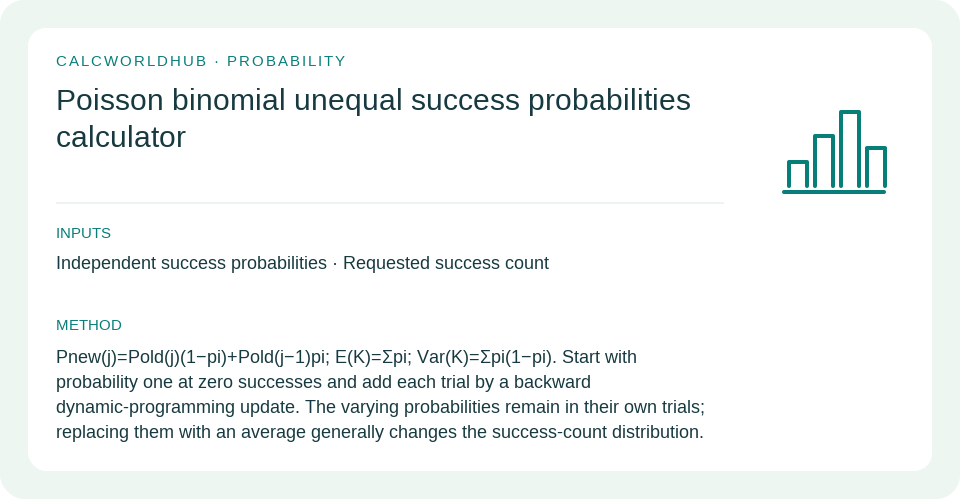
Pnew(j)=Pold(j)(1−pi)+Pold(j−1)pi; E(K)=Σpi; Var(K)=Σpi(1−pi).
Start with probability one at zero successes and add each trial by a backward dynamic-programming update. The varying probabilities remain in their own trials; replacing them with an average generally changes the success-count distribution.
Set up the calculation
p— Independent success probabilities- One independent Bernoulli success probability per trial. Values zero and one are permitted. Use comma-separated values in the stated order.
k— Requested success count- Whole success count to evaluate, between zero and the number of trials. Enter a whole number.
Limits of this model
1–1,000 independent trials with probabilities between zero and one. Dependence, shared latent risk, or sampling without replacement invalidates this model. Extremely small probabilities may round to zero in floating-point arithmetic.
Check this example
Independent success probabilities = 0.1,0.25,0.4,0.65,0.8; Requested success count = 2.
- Probability of exactly k successes: 0.40455
- Probability of at most k successes: 0.63045
- Expected successes: 2.2
- Success-count variance: 0.905
Five trials have chances ranging from 0.1 to 0.8. Their expected successes sum to 2.2, but the probability of exactly two needs the full distribution rather than that mean alone.
Reading the outputs
The exact-count and at-most-count results refer to the same supplied k. A probability of zero or one is allowed and represents a deterministic failure or success.
Frequently asked questions
When does this become an ordinary binomial?
When every trial has the same success probability.
Does rearranging the probabilities change the result?
No. Only their collection matters for the final count distribution.
Can I model correlated conversions?
No. Independence is essential; common audience or time effects need a dependence model.
How do I use the Poisson binomial unequal success probabilities calculator?
Enter Independent success probabilities, Requested success count. Match the units shown beside each field and review the result together with the assumptions below.
What is a worked example of Poisson binomial unequal success probabilities?
Independent success probabilities = 0.1,0.25,0.4,0.65,0.8; Requested success count = 2. Probability of exactly k successes: 0.40455 Probability of at most k successes: 0.63045 Expected successes: 2.2 Success-count variance: 0.905 Five trials have chances ranging from 0.1 to 0.8. Their expected successes sum to 2.2, but the probability of exactly two needs the full distribution rather than that mean alone.
Method reference: SciPy statistical function reference.
Read our calculation methodology.