How to use this calculator
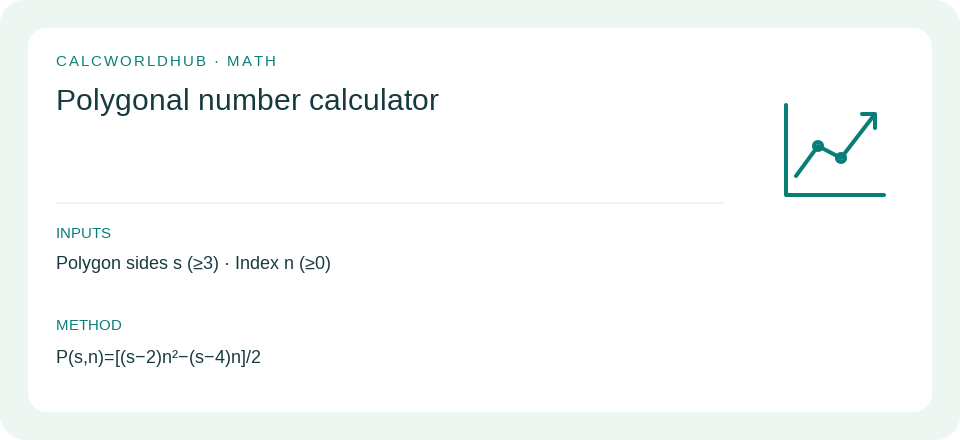
Compute the nth s-gonal figurate number using the standard sequence formula.
- Enter Polygon sides s (≥3), Index n (≥0). Match the units shown beside each field and review the result together with the assumptions below.
- Read the worked example below to check the expected input format and result.
- Compare another scenario by changing one input at a time. Use Reset to return to the starting values.
How Polygonal number calculator works
Compute the nth s-gonal figurate number using the standard sequence formula.
Inputs and units
- Polygon sides s (≥3): Number of polygon sides s; a whole number at least 3.
- Index n (≥0): Sequence index n; a whole number at least 0.
Formula and method
P(s,n)=[(s−2)n²−(s−4)n]/2
Worked example
For pentagonal numbers, s=5 and n=4 gives [(3)(16)−(1)(4)]/2=22.
Interpreting the result
The sequence begins P(s,0)=0 and P(s,1)=1; triangular numbers use s=3.
Assumptions and limits
This is the standard polygonal sequence formula, not the area of a geometric polygon. Large indices may exceed exact integer precision in floating-point display.
Sources and method
- The standard s-gonal number formula defines the corresponding figurate sequence. Wolfram MathWorld polygonal number
Frequently asked questions
Why does index zero give zero?
The sequence counts no points before its first nonzero arrangement.
Is the result always an integer?
For whole-number s≥3 and n≥0, the numerator is even and the formula yields an integer.
How do I use the Polygonal number calculator?
Enter Polygon sides s (≥3), Index n (≥0). Match the units shown beside each field and review the result together with the assumptions below.
What is a worked example of Polygonal number?
For pentagonal numbers, s=5 and n=4 gives [(3)(16)−(1)(4)]/2=22.
What does the Polygonal number calculator calculate?
Compute the nth s-gonal figurate number using the standard sequence formula.