How to use this calculator
Free Pooled proportion calculator. Combine two groups into one proportion using their event and sample counts.
- Enter Group 1 events / Group 2 events, Group 1 sample size / Group 2 sample size. Match the units shown beside each field and review the result together with the assumptions below.
- Read the worked example below to check the expected input format and result.
- Compare another scenario by changing one input at a time. Use Reset to return to the starting values.
Combine event counts without giving groups equal weight
A pooled proportion describes the combined event rate across two groups. It weights each group by its sample size, rather than averaging the two percentages as if the groups were equally large.
Inputs for this calculation
- Group 1 events / Group 2 events: Count observations with the same defined event in each group.
- Group 1 sample size / Group 2 sample size: Enter the total observations for each group; event counts cannot exceed their group totals.
Formula and method
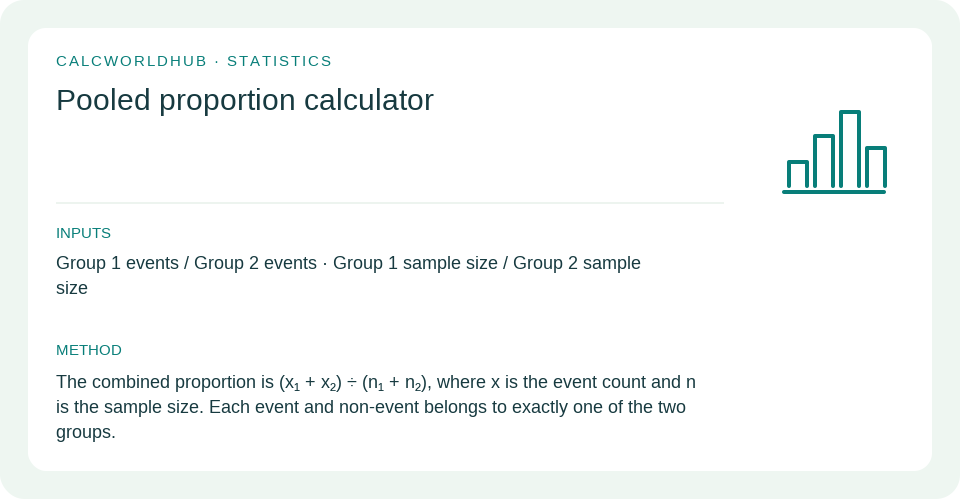
The combined proportion is (x₁ + x₂) ÷ (n₁ + n₂), where x is the event count and n is the sample size. Each event and non-event belongs to exactly one of the two groups.
Worked example
Group 1 has 8 events in 20 observations, while Group 2 has 15 in 30. Pooling gives 23 events among 50 observations: 23 ÷ 50 = 0.46, or 46%. The group rates are 40% and 50%, so their unweighted average would not be the pooled result.
Reading the result
The 46% rate is the descriptive event share across all 50 observations. It does not say that both groups have the same underlying probability.
Assumptions and limits
Pool counts only when combining the groups is meaningful for the question. Hypothesis tests may pool under a particular null hypothesis; confidence intervals often use an unpooled standard error instead.
Related calculators
Frequently asked questions
How do I use the Pooled proportion calculator?
Enter Group 1 events / Group 2 events, Group 1 sample size / Group 2 sample size. Match the units shown beside each field and review the result together with the assumptions below.
What is a worked example of Pooled proportion?
Group 1 has 8 events in 20 observations, while Group 2 has 15 in 30. Pooling gives 23 events among 50 observations: 23 ÷ 50 = 0.46, or 46%. The group rates are 40% and 50%, so their unweighted average would not be the pooled result.
What does the Pooled proportion calculator calculate?
Free Pooled proportion calculator. Combine two groups into one proportion using their event and sample counts.
What assumptions apply to Pooled proportion?
Pool counts only when combining the groups is meaningful for the question. Hypothesis tests may pool under a particular null hypothesis; confidence intervals often use an unpooled standard error instead.
Which method does the Pooled proportion calculator use?
The combined proportion is (x₁ + x₂) ÷ (n₁ + n₂), where x is the event count and n is the sample size. Each event and non-event belongs to exactly one of the two groups.