How to use this calculator
Estimate average and peak-day water demand from population, per-person use, a loss allowance, and a peak factor.
- Enter Population served (people), Billed use per person (L/person/day), Non-revenue water allowance (%), Peak-day factor. Match the units shown beside each field and review the result together with the assumptions below.
- Read the worked example below to check the expected input format and result.
- Compare another scenario by changing one input at a time. Use Reset to return to the starting values.
How this calculation works
A demand planner converts a served population and daily use assumption into a billed volume, then inflates the system input to account for a selected non-revenue share. A peak-day factor provides a simple planning estimate for the larger demand that distribution and treatment assets may need to handle.
Inputs and units
population— Population served (people)- Population included in the planning boundary.
usePerPerson— Billed use per person (L/person/day)- Average billed demand per served person.
nrwPercent— Non-revenue water allowance (%)- Share of system input not billed; enter from zero up to but not including 100%.
peakFactor— Peak-day factor- Peak-day demand divided by average system input demand.
Formula
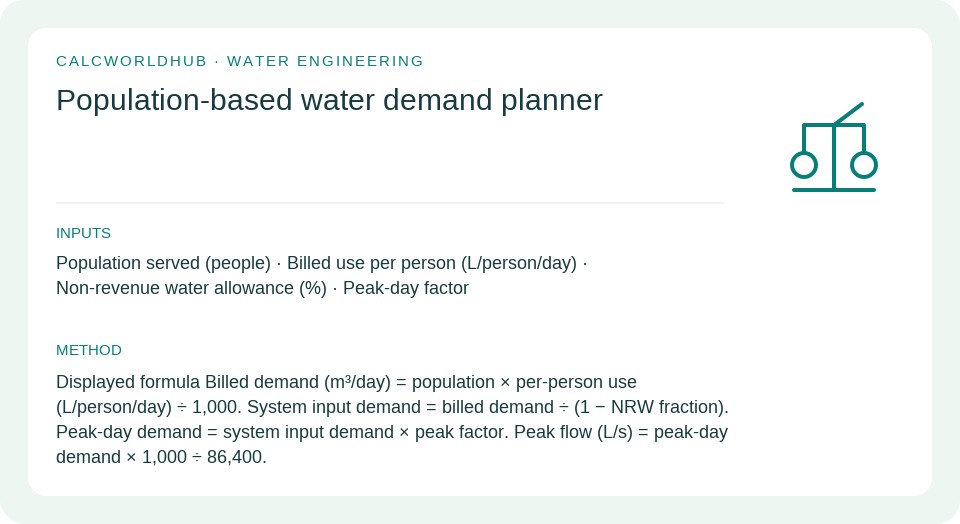
Billed demand (m³/day) = population × per-person use (L/person/day) ÷ 1,000. System input demand = billed demand ÷ (1 − NRW fraction). Peak-day demand = system input demand × peak factor. Peak flow (L/s) = peak-day demand × 1,000 ÷ 86,400.
Method
Enter the population served, average billed use per person per day, non-revenue-water percentage, and peak-day factor. The tool reports average and peak volumes and converts the peak day into an equivalent continuous flow rate.
Worked example
For 10,000 people using 150 L/person/day, billed demand is 1,500 m³/day. With 20% NRW, average system input is 1,875 m³/day; a 1.8 peak factor gives 3,375 m³/day, or about 39.06 L/s.
Assumptions and limits
Per-person use, peak factor, and NRW vary by climate, service level, metering, tourism, and local design standards. This screening calculation does not model hourly peaks, fire flow, storage, pressure, or future demand growth.
Frequently asked questions
Why does NRW increase system input demand?
A fraction of water entering the network is not billed, so dividing billed demand by one minus the NRW share estimates the input needed to deliver that billed volume.
What is a peak-day factor?
It is the ratio of peak-day demand to average demand; use a locally appropriate planning value.
Does this estimate fire flow or hourly peaks?
No. It estimates a peak-day average flow and does not include fire demand or intraday peak patterns.
How do I use the Population-based water demand planner?
Enter Population served (people), Billed use per person (L/person/day), Non-revenue water allowance (%), Peak-day factor. Match the units shown beside each field and review the result together with the assumptions below.
What is a worked example of Population-based water demand planner?
For 10,000 people using 150 L/person/day, billed demand is 1,500 m³/day. With 20% NRW, average system input is 1,875 m³/day; a 1.8 peak factor gives 3,375 m³/day, or about 39.06 L/s.
Reference: U.S. EPA public water-system planning guidance. See our calculation methodology.