Power rule definite integral calculator
Evaluate a real definite power-function integral with a logarithmic branch for exponent −1 and checks for singular intervals.
inputs.
How to use this calculator
Evaluate a real definite power-function integral with a logarithmic branch for exponent −1 and checks for singular intervals.
- Enter Coefficient c, Exponent n, Lower bound, Upper bound. Match the units shown beside each field and review the result together with the assumptions below.
- Read the worked example below to check the expected input format and result.
- Compare another scenario by changing one input at a time. Use Reset to return to the starting values.
How the Power rule definite integral calculator works
Evaluate a real definite power-function integral with a logarithmic branch for exponent −1 and checks for singular intervals.
Inputs and units
- Coefficient c: Finite coefficient c.
- Exponent n: Real exponent n; −1 uses the logarithmic rule.
- Lower bound: Lower integration bound; signed values are allowed where the integrand is real and integrable.
- Upper bound: Upper integration bound; reversed bounds are allowed.
Formula and method
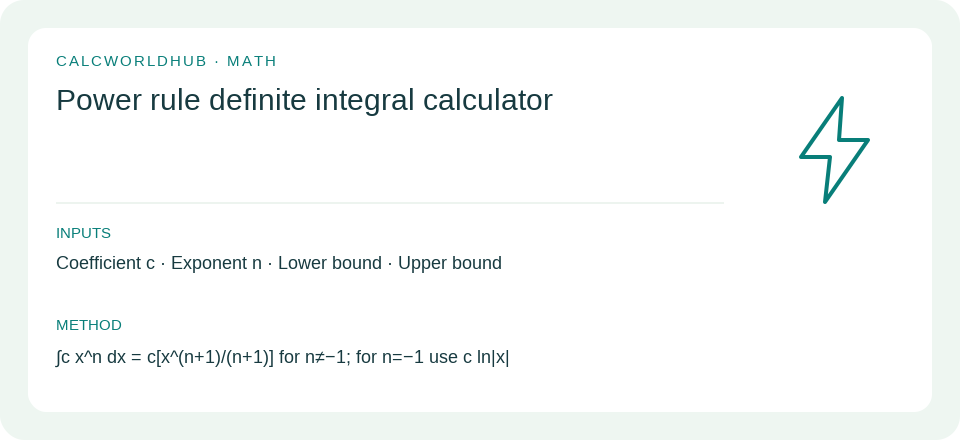
∫c x^n dx = c[x^(n+1)/(n+1)] for n≠−1; for n=−1 use c ln|x|
Worked example
For c=2, n=2, and bounds 1 to 4: (2/3)(64−1)=42. With n=−1 over the same bounds, the result is 2 ln4=2.772589.
Interpreting the result
The signed result reverses if bounds reverse. A finite primitive evaluated on both sides of a singularity is not enough to establish a convergent definite integral.
Assumptions and limits
Noninteger real powers at negative x are outside this tool. An interval touching zero with exponent ≤−1 is rejected for a nonzero coefficient; it has a divergent or undefined ordinary integral.
Sources and method
- Describes endpoint evaluation for integrable functions; singular intervals require a separate convergence check. OpenStax: fundamental theorem of calculus
Frequently asked questions
Can I integrate 2/x² from −1 to 1 by subtracting primitives?
No. The singularity at zero makes that improper integral diverge; a finite endpoint subtraction would be misleading.
What happens for exponent −1?
The calculator uses the logarithmic antiderivative, provided the interval stays away from zero.
How do I use the Power rule definite integral calculator?
Enter Coefficient c, Exponent n, Lower bound, Upper bound. Match the units shown beside each field and review the result together with the assumptions below.
What is a worked example of Power rule definite integral?
For c=2, n=2, and bounds 1 to 4: (2/3)(64−1)=42. With n=−1 over the same bounds, the result is 2 ln4=2.772589.
What does the Power rule definite integral calculator calculate?
Evaluate a real definite power-function integral with a logarithmic branch for exponent −1 and checks for singular intervals.
See the calculation methodology.