Projectile horizontal range calculator
Estimate horizontal projectile range for a launch and landing at the same elevation under constant gravity and no air resistance.
inputs.
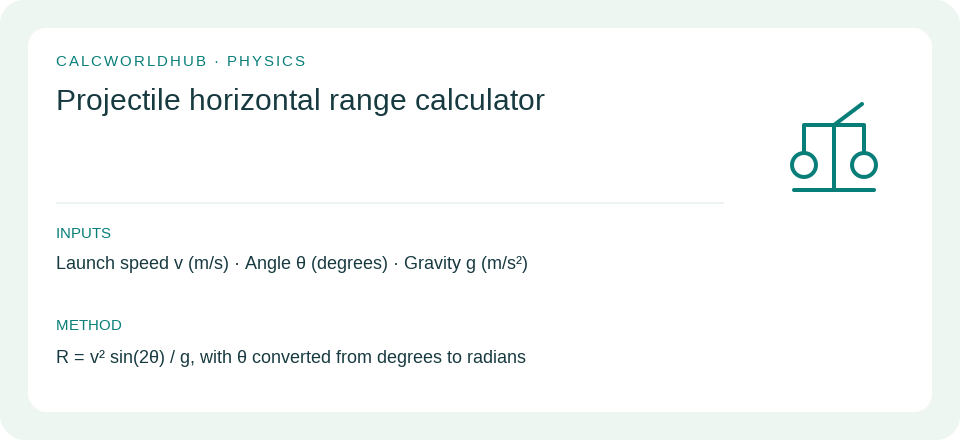
How to use this calculator
Estimate horizontal projectile range for a launch and landing at the same elevation under constant gravity and no air resistance.
- Enter Launch speed v (m/s), Angle θ (degrees), Gravity g (m/s²). Match the units shown beside each field and review the result together with the assumptions below.
- Read the worked example below to check the expected input format and result.
- Compare another scenario by changing one input at a time. Use Reset to return to the starting values.
How the Projectile horizontal range calculator works
Estimate horizontal projectile range for a launch and landing at the same elevation under constant gravity and no air resistance.
Inputs and units
- Launch speed v (m/s): Initial speed in metres/second.
- Angle θ (degrees): Launch angle above the horizontal in degrees.
- Gravity g (m/s²): Positive gravitational acceleration in metres/second squared.
Formula and method
R = v² sin(2θ) / g, with θ converted from degrees to radians
Worked example
At 20 m/s, 35°, and g = 9.81 m/s², R = 400×sin(70°)/9.81 = 38.3157 m.
Interpreting the result
The range is horizontal distance, not the path length. At fixed speed in this ideal model, 45° gives the largest range.
Assumptions and limits
Use a nonnegative speed, angle from 0° to 90°, and positive g. Different landing elevations, drag, wind, and curvature require a different model.
Sources and method
- Derives range for constant gravity with equal launch and landing elevations. OpenStax University Physics: projectile motion
Frequently asked questions
Will 35° and 55° give the same range?
Yes in this level-ground model: sin(70°) = sin(110°). Drag can break this symmetry.
Why is the range zero at 90°?
A vertical launch has no horizontal velocity; the ideal horizontal displacement is zero.
How do I use the Projectile horizontal range calculator?
Enter Launch speed v (m/s), Angle θ (degrees), Gravity g (m/s²). Match the units shown beside each field and review the result together with the assumptions below.
What is a worked example of Projectile horizontal range?
At 20 m/s, 35°, and g = 9.81 m/s², R = 400×sin(70°)/9.81 = 38.3157 m.
What does the Projectile horizontal range calculator calculate?
Estimate horizontal projectile range for a launch and landing at the same elevation under constant gravity and no air resistance.
See the calculation methodology.