Proportion confidence interval
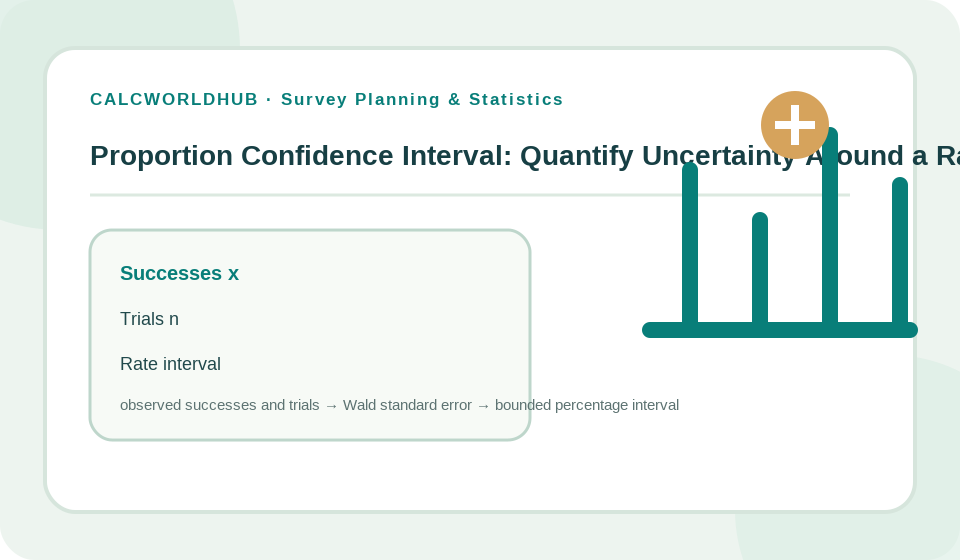
Build a normal-approximation Wald interval for a sample proportion using a critical z value.
Calculator
How to use this calculator
Build a normal-approximation Wald interval for a sample proportion using a critical z value.
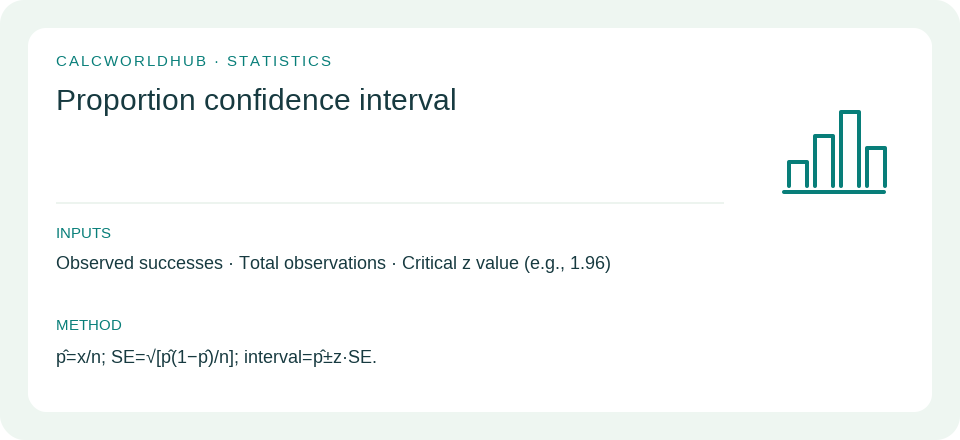
- Enter Observed successes, Total observations, Critical z value (e.g., 1.96). Match the units shown beside each field and review the result together with the assumptions below.
- Read the worked example below to check the expected input format and result.
- Compare another scenario by changing one input at a time. Use Reset to return to the starting values.
Proportion confidence interval
Build a normal-approximation Wald interval for a sample proportion using a critical z value.
What it measures
The sample proportion is x/n. Its estimated standard error is √[p̂(1−p̂)/n], multiplied by the entered z critical value for the half-width.
Inputs and units
- Observed successes: Observed successes x; whole number from zero through n.
- Total observations: Total trials n; positive whole number at least x.
- Critical z value (e.g., 1.96): Positive normal critical z multiplier, such as 1.96 for an approximate 95% interval.
Formula and method
p̂=x/n; SE=√[p̂(1−p̂)/n]; interval=p̂±z·SE.
Worked example
54 successes in 100 trials gives p̂=0.54; with z=1.96, the approximate interval is 44.23% to 63.77%.
Interpreting the result
The interval is a repeated-sampling procedure, not a probability statement that this fixed interval contains the parameter with 95% probability.
Assumptions and limits
The Wald interval can perform poorly for small samples or proportions near 0 or 1. For formal inference, consider a score or exact interval and check independence and sampling design.
Sources and method
- Describes the approximate interval p′ ± z√(p′q′/n), its error bound, and the normal approximation context for a population proportion. OpenStax Statistics 8.3: A population proportion
Frequently asked questions
Is the input a confidence percentage?
No. It is a critical z value; 1.96 is commonly used for an approximate 95% interval.
Is this interval reliable for small samples?
The Wald method can be inaccurate at small n or near boundary proportions.
How do I use the Proportion confidence interval?
Enter Observed successes, Total observations, Critical z value (e.g., 1.96). Match the units shown beside each field and review the result together with the assumptions below.
What is a worked example of Proportion confidence interval?
54 successes in 100 trials gives p̂=0.54; with z=1.96, the approximate interval is 44.23% to 63.77%.
What does the Proportion confidence interval calculate?
Build a normal-approximation Wald interval for a sample proportion using a critical z value.
See the calculation methodology.
Good calculators show their work.
CalcWorldHub is built around clear inputs and visible assumptions. Results are estimates for planning; check official sources or your provider’s terms when exact figures matter.