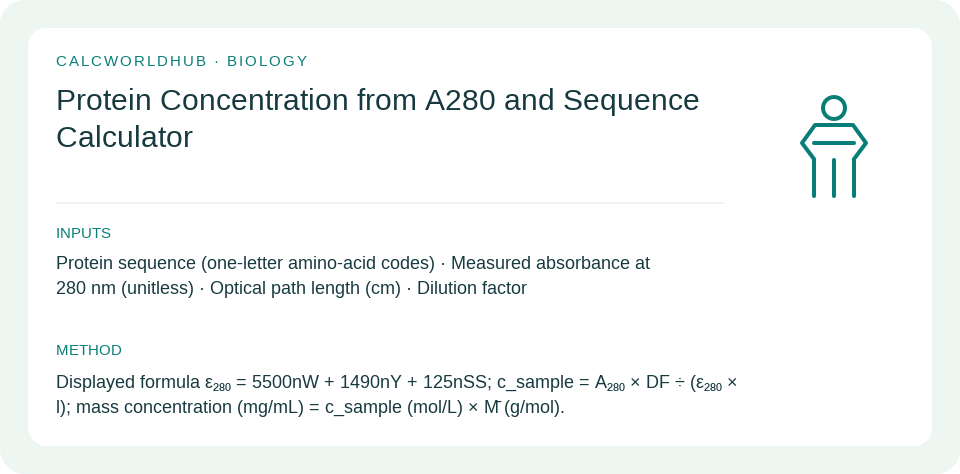
How to use this calculator
Estimate protein concentration at 280 nm from absorbance, path length, dilution, and the amino-acid sequence.
- Enter Protein sequence (one-letter amino-acid codes), Measured absorbance at 280 nm (unitless), Optical path length (cm), Dilution factor, then complete the remaining labeled fields. Match the units shown beside each field and review the result together with the assumptions below.
- Read the worked example below to check the expected input format and result.
- Compare another scenario by changing one input at a time. Use Reset to return to the starting values.
How this calculation works
This workflow derives an approximate 280 nm molar extinction coefficient from a protein sequence before applying Beer–Lambert concentration. Enter the absorbance measured on the diluted sample, its optical path, and the dilution factor to estimate the concentration of the original sample in both molar and mass units.
Inputs and units
sequence— Protein sequence (one-letter amino-acid codes)- Use the mature chain sequence for the species actually measured; spaces and line breaks are ignored.
absorbance— Measured absorbance at 280 nm (unitless)- Enter the instrument reading for the diluted sample, not a value already corrected back to the stock concentration.
pathLengthCm— Optical path length (cm)- Effective sample path through the cuvette or plate well, in centimetres.
dilutionFactor— Dilution factor- Use 1 for an undiluted sample; for a 1:10 dilution enter 10.
disulfidePairs— Disulfide-linked cysteine pairs- Enter the number of cystine pairs expected in the measured protein; each pair contributes one cystine term.
Formula
ε₂₈₀ = 5500nW + 1490nY + 125nSS; c_sample = A₂₈₀ × DF ÷ (ε₂₈₀ × l); mass concentration (mg/mL) = c_sample (mol/L) × M̄ (g/mol).
Method
Count tryptophan (W) and tyrosine (Y) residues in the sequence and enter the number of disulfide-linked cysteine pairs (SS). Estimate ε₂₈₀ in M⁻¹·cm⁻¹, calculate the diluted-sample molarity from absorbance and path length, then multiply by the dilution factor. The numeric result in g/L is equal to mg/mL.
Worked example
For MKWVTFISLLFLFSSAYS with A₂₈₀ = 0.50, a 1 cm path, dilution factor 10, and no disulfide pairs entered, ε₂₈₀ = 6,990 M⁻¹·cm⁻¹ and the estimated original concentration is 715.308 µmol/L or 1.531 mg/mL.
Assumptions and limits
This estimate assumes a clear sample measured at 280 nm, a path length in centimetres, and no other chromophores that materially absorb at that wavelength. Sequence-based extinction coefficients can be less reliable for proteins without tryptophan; aggregation, buffer effects, incorrect dilution, or an incorrect disulfide count can change the result. A zero coefficient cannot produce an A280 concentration estimate.
Frequently asked questions
Should I enter the diluted or stock-sample absorbance?
Enter the measured diluted-sample reading and enter the dilution factor separately; the result is multiplied by that factor once.
How does the sequence determine ε₂₈₀?
The estimate uses 5,500 per tryptophan, 1,490 per tyrosine, and 125 per disulfide-linked cysteine pair, in M⁻¹·cm⁻¹.
Why does the disulfide-pair count matter?
The method assigns a small absorbance contribution to cystine; reduced cysteines do not count as cystine pairs.
Can this replace a measured standard curve?
No. It is a sequence-based estimate. A validated assay or experimentally determined extinction coefficient is preferable when concentration accuracy is critical.
How do I use the Protein Concentration from A280 and Sequence Calculator?
Enter Protein sequence (one-letter amino-acid codes), Measured absorbance at 280 nm (unitless), Optical path length (cm), Dilution factor, then complete the remaining labeled fields. Match the units shown beside each field and review the result together with the assumptions below.
Reference: ExPASy ProtParam documentation for sequence-derived 280 nm extinction coefficients and absorbance assumptions. See our calculation methodology.