Pythagorean theorem solver
Solve one unknown side of a right triangle from the other two using a²+b²=c².
Calculator
How to use this calculator
Solve one unknown side of a right triangle from the other two using a²+b²=c².
- Enter Leg a, Leg b, Hypotenuse c, Missing side. Match the units shown beside each field and review the result together with the assumptions below.
- Read the worked example below to check the expected input format and result.
- Compare another scenario by changing one input at a time. Use Reset to return to the starting values.
Pythagorean theorem solver
Solve one unknown side of a right triangle from the other two using a²+b²=c².
What it measures
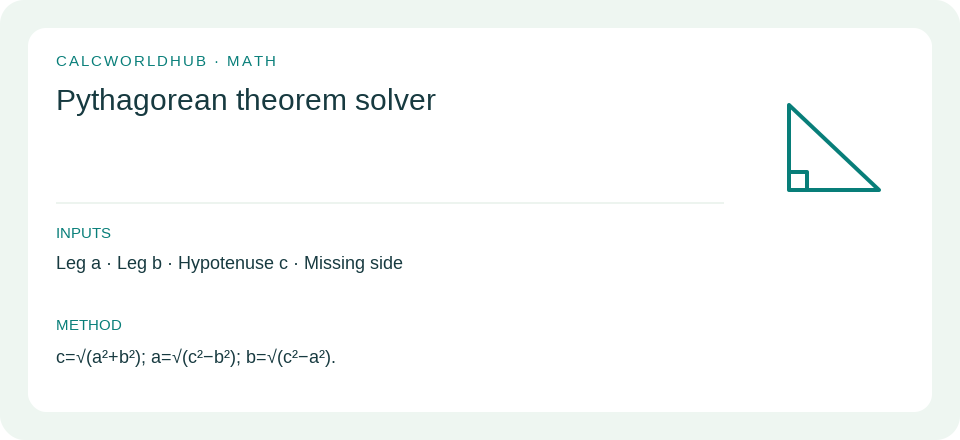
The hypotenuse c is opposite the 90° angle and is the longest side. If a leg is missing, subtract the known leg square from c² before taking the square root.
Inputs and units
- Leg a: Length of leg a; positive and perpendicular to leg b.
- Leg b: Length of leg b; positive and perpendicular to leg a.
- Hypotenuse c: Hypotenuse c, the side opposite the right angle; use only when solving for a leg.
- Missing side: Choose which one side is unknown. The other two values supply the equation.
Formula and method
c=√(a²+b²); a=√(c²−b²); b=√(c²−a²).
Worked example
Legs 3 and 4 give c=√(9+16)=5. If c=5 and b=4, the missing leg is √(25−16)=3.
Interpreting the result
The answer is a length in the same units as the entered sides; the squared terms use squared units.
Assumptions and limits
Applies only to a right triangle. Side lengths must be positive, and a known leg must be shorter than the hypotenuse.
Sources and method
- States the right-triangle relation a²+b²=c²; triangle examples use their stated area formulas and domain limits. OpenStax Prealgebra 9.3: Triangles and Pythagorean theorem
Frequently asked questions
Which side is the hypotenuse?
It is opposite the right angle and is always the longest side.
Can this solve a non-right triangle?
No. The squared-side relationship requires a 90° angle.
How do I use the Pythagorean theorem solver?
Enter Leg a, Leg b, Hypotenuse c, Missing side. Match the units shown beside each field and review the result together with the assumptions below.
What is a worked example of Pythagorean theorem solver?
Legs 3 and 4 give c=√(9+16)=5. If c=5 and b=4, the missing leg is √(25−16)=3.
What does the Pythagorean theorem solver calculate?
Solve one unknown side of a right triangle from the other two using a²+b²=c².
See the calculation methodology.
Good calculators show their work.
CalcWorldHub is built around clear inputs and visible assumptions. Results are estimates for planning; check official sources or your provider’s terms when exact figures matter.